
LILLY PILLY

- Botanical name
- Syzygium smithii
- Also known as
- Common Lilly Pilly, Lillipilli, Acmena smithii (former name), Eugenia smithii (basionym)
- Main flavour compound
- Malic acid
- Part used
- Fruit (the edible white-to-maroon berry); fresh, or cooked into jam, cordial and syrup
- Method of cultivation
- An evergreen rainforest tree of the myrtle family (Myrtaceae). In the wild it reaches 15–20 metres, but in cultivation it usually settles to a dense 8–10 metres and takes happily to pruning, which is why it is so widely planted as a hedge and street tree. It is native to the east-coast rainforests of mainland Australia, typically along stream and river banks from sea level up to around 1,200 metres.
- Commercial preparation
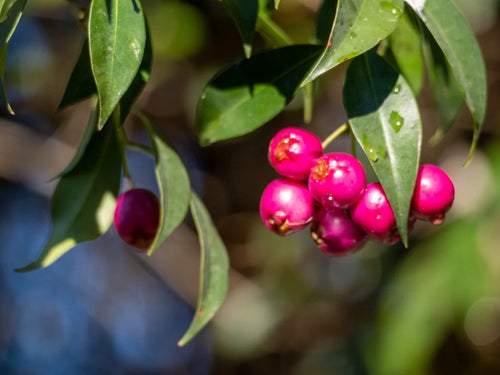
- The cream-white flowers (October–March) give way to clusters of small berries (roughly 8–20 mm, white through pink to maroon) that ripen May–August. The fruit is hand-picked ripe and used fresh, or cooked down into jams, jellies, cordials and syrups to concentrate its tart character. For gin it is most often macerated and distilled, with several Australian makers also infusing the berries post-distillation for colour and soft red-berry fruit.
- Non-culinary uses
- Widely grown as an ornamental hedge and street tree, and notably resistant to the lilly pilly psyllid that disfigures many other species in the group.
Lilly pilly is Syzygium smithii — an evergreen tree of the myrtle family that grows to 15–20 metres in its wild rainforest home but is usually kept to a tidy 8–10 metres in gardens, where it takes so kindly to the shears that it has become one of Australia's favourite hedges and street trees. [source] It is native to the east-coast rainforests of mainland Australia, hugging stream and river banks from north-east Queensland down through New South Wales and Victoria to Wilsons Promontory. [source] Worth knowing: "lilly pilly" is a common name shared by dozens of Syzygium species — S. smithii is simply the classic one, the tree most people picture when they hear the words. [source] It is a different species from riberry (S. luehmannii), which we cover separately.
Fresh berry
Light, crunchy and tart; eat raw (discard the large seed) or macerate in base spirit. Best used quickly — like most soft native fruit it does not keep.
Jam, cordial or syrup
The traditional preparation — cooking concentrates the fruit's mild acidity and pink colour into something far more expressive than the raw berry.
Region of cultivation
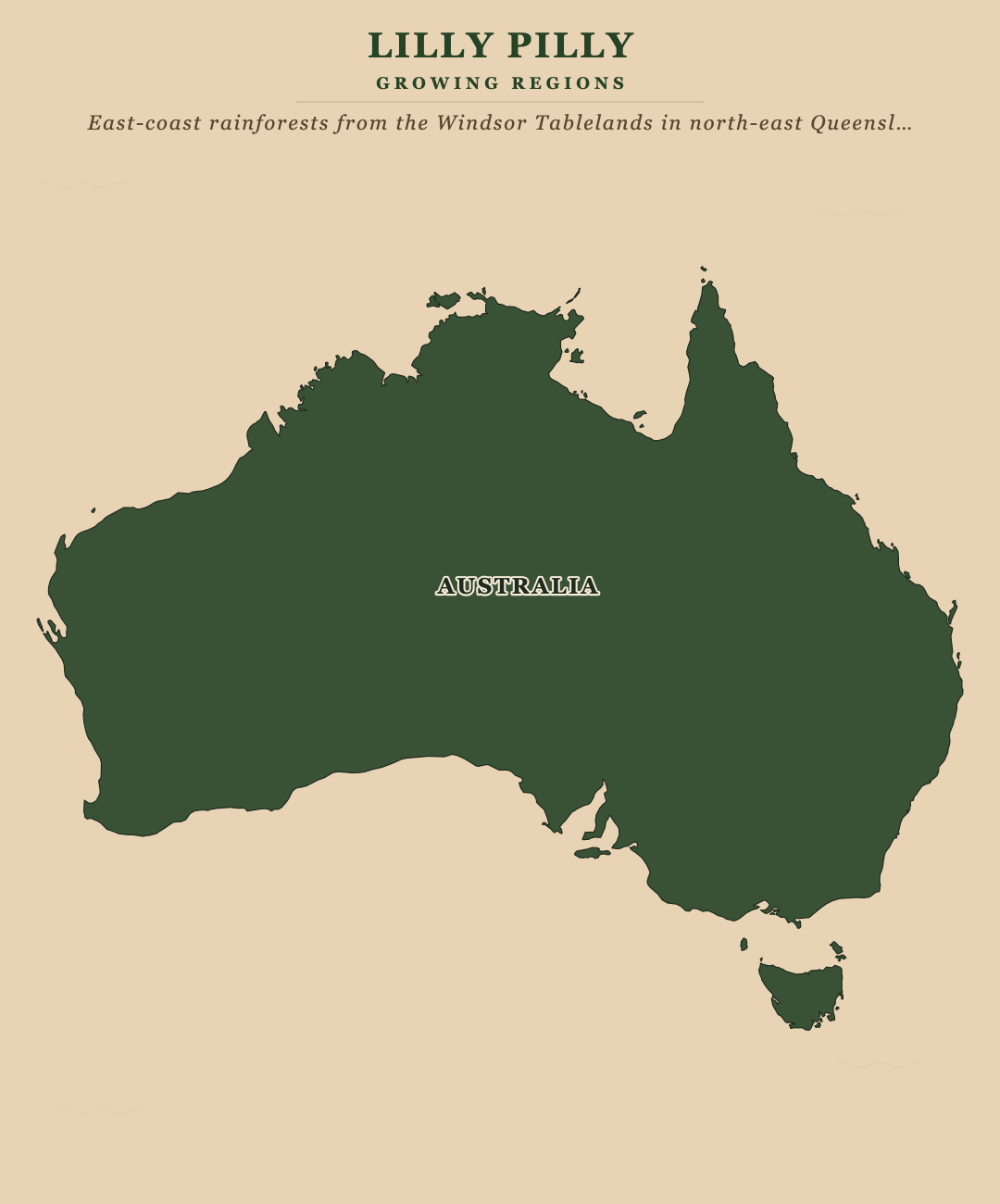
Lilly Pilly is native to Australia, Eastern Australia rainforest, with secondary growing regions in Queensland, New South Wales, Victoria. East-coast rainforests from the Windsor Tablelands in north-east Queensland, south through New South Wales and Victoria to Wilsons Promontory (and on King Island), typically along stream and river banks.
Spice Story
Cream-white flowers cluster along the branches from October to March, and by the southern winter — May through August — they have become bunches of small berries, 8 to 20 millimetres across, ripening from white through pink to a deep maroon. [source] The fruit has long been food: the botanist Joseph Maiden noted in 1889 that the berries were "eaten by the aboriginals, small boys, and birds." [source] Its taste divides opinion — some describe a light, crunchy, tart fruit with notes of clove and cranberry, others find it mild and watery, "somewhat lacking in taste," with plenty of variation between trees and stages of ripeness. [source] That is exactly why cooks reach for it as a jam, jelly, cordial or syrup: cooking concentrates the mild acidity and the rosy colour into something far more expressive than the raw berry. [source]
Gin Creativity
Lilly pilly is a colour-and-freshness botanical more than a powerhouse. Its gift to a gin is a crisp, apple-and-cranberry tartness and, where the berries are skin-on or infused, a soft pink blush — which is why it so often anchors the pretty, summery end of the Australian native shelf. Treat it the way you would a tart orchard fruit: lean on it for brightness and a clean acid lift behind juniper, rather than expecting a single loud flavour. It sits beautifully alongside other natives — riberry, native lime, the citrus oils — and a backbone of coriander seed keeps the whole thing from drifting too sweet.
Blending Science
Main flavour compounds
 Malic acid—
 Citric acid—
 Cyanidin-3-glucoside—
 alpha-Pinenefresh pine, top note
Pairs well with
- Juniper
- Coriander seed
- Native lime
- Riberry
- Blood orange
The fruit's signature is tartness, and that tartness is the work of organic acids: malic acid, the same apple-acid that gives the berry its refreshing, faintly astringent bite, and citric acid, sharper and faster on the tongue — both are characteristic of native Syzygium fruit. [source] The pink-to-maroon colour comes from anthocyanins; Australian Syzygium berries are notably rich in them, with cyanidin-type pigments among the principal players, which is what lends an infused gin its blush. [source] As a member of the Myrtaceae, the plant also carries fresh, resinous terpenes such as alpha-pinene — well documented across the lilly-pilly group — that read as a clean, piney lift. [source] Cool, gentle extraction protects both the delicate acids and the colour; hard heat dulls the brightness first.
Food Partners
- Soft cheeses: the fruit's clean tartness cuts richness the way a good apple chutney would.
- Roast pork and game: a lilly pilly glaze or jelly is a classic foil for fatty, savoury meat.
- Apple and pear desserts: the malic, orchard-fruit acidity echoes straight into a tart or crumble.
- Cured meats: sweet-tart berry against salt and fat.
- Dark berries and chocolate: the anthocyanin-rich, cranberry-leaning fruit bridges happily to cocoa and blackberry.
Cocktails To Try

- Lilly Pilly Clover Club: the elegant raspberry-and-egg-white classic, reimagined with lilly pilly in place of the raspberry syrup — the apple-cranberry tartness gives the silky foam a crisp, blushing native edge.
- Native Bramble: a Bramble of gin, lemon and sugar over crushed ice, with a lilly-pilly syrup drizzled through instead of crème de mûre — clean orchard-tart fruit and a rosy stain bleeding down the glass.
- Lilly Pilly Gin Fix: the old berry classic of gin, lemon, sugar and crushed ice, made with muddled lilly pilly — the apple-cranberry tartness and rosy stain over the ice make it a clean, refreshing native long drink.
Release The Flavour
- Heat: keep it gentle — cool extraction protects the fragile acids and the pink anthocyanin colour; hard heat flattens both.
- Alcohol: a fine solvent for the berry's pigments and fruit character; macerate skin-on before distilling, or infuse post-distillation for the strongest colour.
- Time: the raw fruit is mild, so give it a generous maceration, and consider a short post-distillation infusion to pull through the blush.
- Less is more — for flavour, but not for colour: lean on lilly pilly for brightness and that rosy hue rather than a single dominant taste; let juniper and the other natives carry the structure.
Discover more
From the same region
Pairs well with
Same flavour family

Surprise me

Sources & Citations
- scientific_name (Syzygium smithii (Poir.) Nied., Myrtaceae; basionym Eugenia smithii Poir.; ACCEPTED):GBIF Backbone Taxonomy, usageKey 3184410 — api.gbif.org/v...
- name_change (formerly Acmena smithii; Acmena merged into a broadly circumscribed Syzygium after 2000s phylogenetic analyses; binomial Syzygium smithii since Niedenzu 1893):en.wikipedia.org/wiki/Syzygium_smithii
- plant_form (evergreen Myrtaceae tree; 15–20 m wild, 8–10 m in cultivation; responds to pruning; widely used as hedge/street tree; psyllid-resistant):anpsa.org.au/plant_profiles/syzygium-smithii/
- flowers_and_fruit (cream-white flowers Oct–Mar; berries 0.8–2 cm, white to maroon, ripen May–Aug; edible, mildly acidic):en.wikipedia.org/wiki/Syzygium_smithii
- distribution (rainforests from Windsor Tablelands NE Qld south through NSW and Victoria to Wilsons Promontory; also King Island; riparian, sea level to ~1,200 m):en.wikipedia.org/wiki/Syzygium_smithii
- fruit_taste_variation (described both as light/crunchy/tart with clove + cranberry/apple notes AND as mild/watery/"somewhat lacking in taste" — taste varies by cultivar/ripeness):tropical.theferns.info/viewtropical.php?id=Syzygium+smithii
- culinary_use (eaten raw seed-removed; made into jams, jellies, cordials, drinks):tropical.theferns.info/viewtropical.php?id=Syzygium+smithii
- organic_acids (native Syzygium fruit tartness driven by organic acids incl. citric/malic; malic = refreshing astringent tartness, citric = sharp fast sourness; quinic + citric most abundant in S. aqueum):Valorisation of Three Underutilised Native Australian Pla...
- anthocyanin_colour (Australian Syzygium fruits high in anthocyanins; pink-to-crimson berry colour; cyanidin among the major Syzygium anthocyanins):Physicochemical composition, antioxidant and anti-prolife...
- terpene_genus_note (alpha-pinene a dominant terpene in lilly-pilly volatile oil — reported for S. paniculatum, used here as a genus/Myrtaceae aromatic note, NOT a quantified S. smithii fruit value):Physicochemical composition... (Syzygium paniculatum) ext...
- gin_tamborine (Tamborine Mountain Distillery Lilly Pilly Gin — native lilly pilly berries, juniper, coriander, citrus; sweet-tart, crisp finish):tamborinemountaindistillery.com/products/lilly-pilly-gin
- gin_manly (Manly Spirits Co. Lilly Pilly Pink Gin — 12 botanicals incl. lilly pilly + riberry, native limes, raspberry, blood orange; soft red-berry pink gin):manlyspirits.com.au/products/lilly-pilly-pink-gin
- compound_cids (PubChem):PubChem CIDs — malic acid 525, citric acid 311, cyanidin-3-glucoside 441667, alpha-pinene 6654
- hero_image:iStock royalty-free licence (asset 1276849815)
