
LEMON ASPEN

- Botanical name
- Acronychia acidula
- Also known as
- Lemon wood, Lemon aspen tree
- Main flavour compound
- Limonene
- Part used
- Dried whole fruit or dried peel
- Method of cultivation
- Small to medium rainforest tree of the Rutaceae family (the citrus family), endemic to the rainforests of Queensland — particularly the Atherton Tableland to the Eungella Range. The tree grows up to 27 metres in wild rainforest, smaller in cultivation. Commercial small-scale plantations exist along the east coast from North Queensland to northern NSW. The pale yellow-white fruit is marble-sized, about 2 cm in diameter, with a distinct citrus character that combines grapefruit, lime and eucalypt notes.
- Commercial preparation
- Fruit is hand-picked at full maturity, washed, sliced or used whole, and either freeze-dried or low-temperature dehydrated for the dried-spice market. Some commercial production is also sold fresh-frozen.
- Non-culinary uses
- Native Australian bushfood market — sauces, beverages, confectionery; the antioxidant-rich fruit is studied for nutritional and cosmetic uses; some traditional Indigenous medicinal use.
Lemon Aspen — Acronychia acidula — is a tall rainforest tree of the Rutaceae family (the true citrus family), endemic to the wet tropical rainforests of Queensland. Wild trees can reach 27 metres tall, growing at altitudes up to 1,000 metres in the rainforest country between the Atherton Tableland and the Eungella Range. [source] The fruit is pale yellow-white, marble-sized, smooth-skinned, and produces a distinctive flavour combining grapefruit, lime and a slightly eucalypt-bright background that no introduced citrus matches.
Dried whole fruit
The standard form — slow extraction in cool maceration.
Dried peel chips
Concentrated peel-oil version; faster extraction.
Region of cultivation
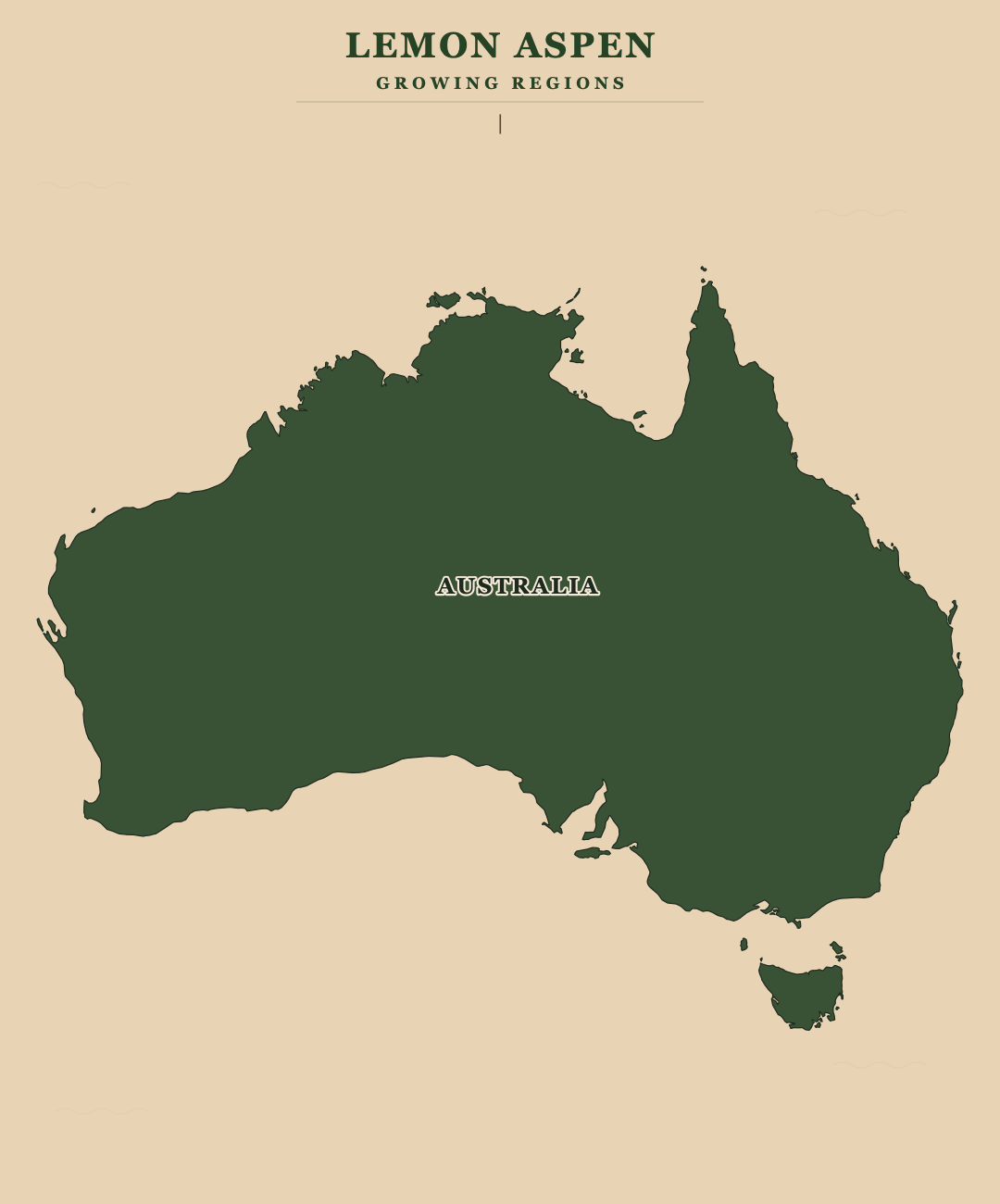
Lemon Aspen is native to Australia, Australia — Queensland rainforest (Atherton Tableland to Eungella Range), with secondary growing regions in Small commercial plantations in north Queensland and northern NSW. |
Spice Story
Lemon Aspen has been a traditional Indigenous bushfood for tens of thousands of years across its rainforest range. Modern commercial cultivation is small-scale and bushfood-driven, with small native-food plantations along the east coast from North Queensland into northern NSW. The fruit appears in modern Australian native-cuisine across sauces, confectionery, beverages and increasingly in craft cocktails and gin. In gin specifically, Lemon Aspen provides a clearly Australian native-citrus alternative to imported lemon, with a tart-grapefruit-eucalypt complexity unique to this plant.
Gin Creativity
Lemon Aspen brings tart-citrus brightness with a faintly eucalypt-edged finish. A full sachet pushes a gin firmly into native-citrus territory; a half-sachet provides quiet aromatic brightness that integrates with juniper. Pair with lemon myrtle and finger lime for a fully native citrus profile, or with pepperberry and anise myrtle for a bush-spice blend.
Blending Science
Main flavour compounds
 Limoneneclean citrus lift
 Pinenefresh pine, top note
 Citrallemon-bright
 Citric acid—
Pairs well with
Limonene dominates as in all citrus. Alpha-pinene layers a faintly eucalypt-resinous edge that distinguishes Lemon Aspen from other citrus. Citral provides the bright lemon-leaning top. Citric acid is present in significant amounts (the species epithet acidula means "slightly acid"), contributing the tart edge that lifts the citrus character. Cool extraction preserves the bright top; warm extraction develops a softer character.
Food Partners
- Native fish marinades — Lemon Aspen and lemon myrtle on grilled native fish.
- Sparkling citrus drinks — Lemon Aspen syrup in soda water.
- Citrus marmalades — Lemon Aspen marmalade is a Queensland speciality.
- Tropical fruit salads — Lemon Aspen syrup over mango and lychee.
- Dessert glazes — Lemon Aspen syrup over panna cotta or sorbet.
Cocktails To Try

- Native G&T — Lemon Aspen gin, native tonic, fresh native garnish.
- Australian Gimlet — Lemon Aspen gin, lime cordial, native lemon garnish.
- Bushland Sour — Lemon Aspen gin, wattle-seed syrup, lemon.
Release The Flavour
- Cool extraction — preserves the bright citrus top.
- Brief contact — 2–6 hours captures freshness.
- Whole fruit — releases character slowly.
- Source matters — small-batch Queensland bushfood production is the standard.
Discover more
Pairs well with
Same flavour family
Surprise me

Sources & Citations
- scientific_name (Acronychia acidula, Rutaceae):en.wikipedia.org/wiki/Acronychia_acidula
- endemic_to_queensland_rainforest:en.wikipedia.org/wiki/Acronychia_acidula
- altitude_range (Atherton Tableland to Eungella Range, up to 1000m):en.wikipedia.org/wiki/Acronychia_acidula
- grapefruit_lime_flavour:en.wikipedia.org/wiki/Acronychia_acidula
- small_scale_commercial_cultivation:en.wikipedia.org/wiki/Acronychia_acidula
- main_flavour_compounds (CSV-sourced):inputs/source.csv — Lemon Aspen row
