
GENTIAN ROOT

- Botanical name
- Gentiana lutea
- Also known as
- Yellow gentian, Great yellow gentian, Bitterwort
- Main flavour compound
- Amarogentin
- Part used
- Dried root (mature taproot, harvested after 7+ years)
- Method of cultivation
- Long-lived perennial herb of the Gentianaceae family, native to alpine and sub-alpine pastures across the Alps, the Pyrenees, the Apennines and the Carpathians (and similar mountain habitats in the Himalayas). The roots take 7–10 growing seasons to mature. Cultivation has largely replaced wild harvest in the protected populations of the Auvergne (France) and parts of the European Alps.
- Commercial preparation
- Mature roots are dug in autumn, washed thoroughly, sliced and dried gently to preserve the bitter glycosides. Quality is graded on size, freshness of dry and absence of mould.
- Non-culinary uses
- Foundational base for bitters and digestif liqueurs across Europe — gentian is the main flavour of the German digestif Underberg, of Angostura bitters, of Peychaud's Bitters, of Suze, and of dozens of Alpine *amer*; traditional digestive medicine since classical Greek and Roman times.
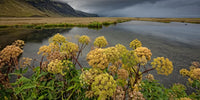
Gentian — Gentiana lutea, the great yellow gentian — is a tall perennial of the Gentianaceae family, native to alpine and sub-alpine pastures across the high country of Europe, from the Alps to the Pyrenees to the Carpathians. The plant grows about a metre tall, with broad ribbed leaves and tall stems topped with whorls of star-shaped yellow flowers in mid summer. What we use is the deep, fleshy taproot, which takes 7–10 years to reach commercial maturity — one of the longest pre-harvest periods of any common spice. [source] The protected status of wild populations (especially in the French Auvergne) means most commercial supply now comes from cultivation.
Dried slices
The standard form — slow-extracting in alcohol.
Chopped or chipped
Faster extraction; harder to portion uniformly.
Region of cultivation
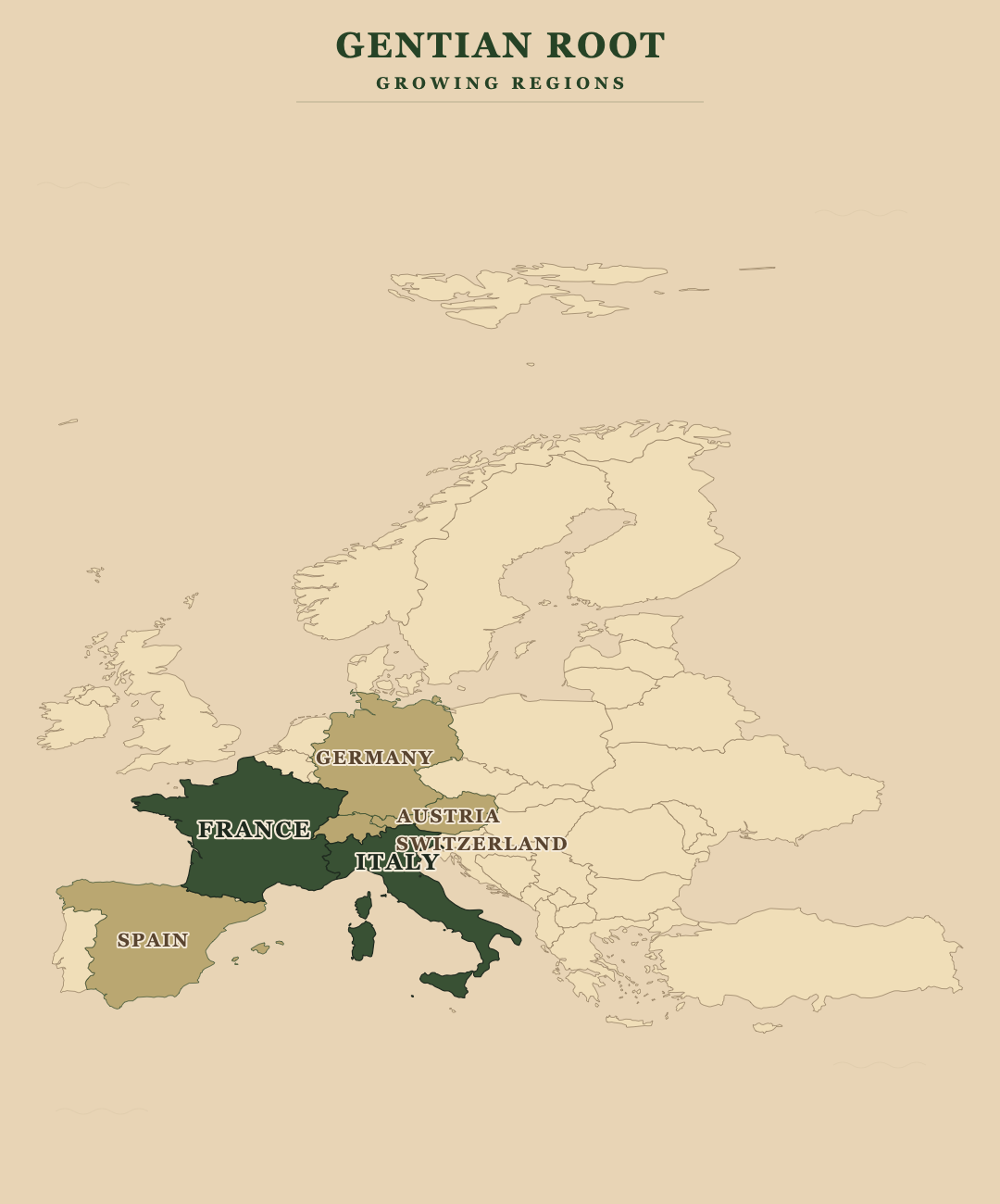
Gentian Root is primarily cultivated in France (Auvergne, Massif Central), Italian Alps, Pyrenees, with secondary growing regions in Switzerland, Austria, Spain, Germany.
Spice Story
Gentian root is the bitter heart of European drinks tradition. The root has been used since classical Greek and Roman times — named after Gentius, the 2nd-century-BCE king of Illyria who reputedly discovered its medicinal properties — and is the foundational bitter principle in a remarkable range of European drinks: the German digestif Underberg, Angostura bitters, Peychaud's Bitters (used in the Sazerac), the French aperitif Suze, and dozens of Alpine amer and amaro liqueurs. [source] Its active compound amarogentin is among the most intensely bitter substances found in nature — detectable in dilutions of one part in fifty thousand. In gin, gentian root is a less-common but historically authentic botanical — used in some traditional London Drys and in bitters-focused contemporary craft expressions.
Gin Creativity
Gentian root brings clean, intense bitterness without aromatic distraction. A quarter sachet is often enough — full sachet use can push a gin into amaro territory and overpower more delicate botanicals. Pair with angelica root and orris for structural depth, or with citrus peel for a "Suze-leaning" aperitif gin. Avoid pairing with very subtle florals — gentian's bitterness buries them.
Blending Science
Main flavour compounds
 Amarogentin—
 Gentiopicrin (gentiopicroside)—
 Gentianine—
 Mangiferin—
Pairs well with
- Angelica root
- Orris root
- Citrus peel
- Cardamom
- Cinchona bark
The chemistry is dominated by secoiridoid glycosides. Amarogentin is the most bitter compound — and possibly the most bitter naturally-occurring compound known. Gentiopicrin (gentiopicroside) is the more abundant secoiridoid contributing the deeper bitter body. Gentianine is an alkaloid contributing further bitter depth. Mangiferin is a xanthone contributing astringency. [source] These compounds are alcohol-soluble and slow to extract — gentian gin needs long maceration (48+ hours) for full development. They are also heat-stable.
Food Partners
- Bitter Italian aperitifs and amari — gentian's natural partners.
- Pre-dinner digestifs — gentian gin neat as an aperitif.
- Strong cheese boards — bitter and rich find each other.
- Game-meat reductions — gentian-gin glaze over venison or wild boar.
- Dark chocolate desserts — bitter on bitter.
Cocktails To Try

- Bitter Negroni — gentian-rich gin, Campari, vermouth.
- Suze and Tonic-style — gentian-rich gin, tonic, fresh lemon — a softer Suze alternative.
- Sazerac (with gentian gin) — gentian-gin in place of rye, Peychaud's, absinthe rinse.
Release The Flavour
- Long extraction — 48+ hours for full bitter development.
- Heat is friendly — both vapour and warm maceration work cleanly.
- Use sparingly — gentian's bitterness builds across a blend.
- Pair carefully — gentian rewards being placed alongside aromatic botanicals it can support.
Discover more
From the same region
Pairs well with
Same flavour family
Surprise me

Sources & Citations
- scientific_name (Gentiana lutea, Gentianaceae):en.wikipedia.org/wiki/Gentiana_lutea
- 7-10_year_root_maturation:www.healthyhildegard.com/gentian-root-bitters/
- native_alpine_range:en.wikipedia.org/wiki/Gentiana_lutea
- amarogentin (most bitter natural compound; 1:50000 detectable):en.wikipedia.org/wiki/Gentiana_lutea
- use_in_underberg_angostura_peychauds_suze:en.wikipedia.org/wiki/Gentiana_lutea
- main_flavour_compounds (CSV-sourced):inputs/source.csv — Gentian Root row
