
FIG

- Botanical name
- Ficus carica
- Also known as
- Common Fig, Cultivated Fig, Edible Fig
- Main flavour compound
- Hexanal
- Part used
- Fruit (fresh or dried); leaf used in fragrance/gin for its green note
- Method of cultivation
- A deciduous tree or large shrub of the mulberry family (Moraceae), growing 7–10 metres tall with smooth white bark and deeply lobed leaves. It thrives across the warm, dry Mediterranean and western-Asian climate, from sea level up to around 1,700 metres, and tolerates poor, rocky ground that defeats thirstier fruit trees.
- Commercial preparation
- Figs are hand-harvested ripe, then either sold fresh for immediate use or sun- and tunnel-dried to concentrate their sugars for year-round trade. For gin, dried figs are commonly cold vacuum-distilled (room temperature, no heat) so the jammy sweetness survives, and the distillate is blended back into the spirit.
- Non-culinary uses
- Fig-leaf absolute was once prized in perfumery for its crushed-green, lactonic scent, but was restricted by IFRA in 2006 over the phototoxic furanocoumarins (psoralens) in the leaf — most modern fig notes are now reconstructed synthetically.
The fig — Ficus carica — is a deciduous tree or sprawling large shrub of the mulberry family, reaching 7–10 metres with smooth, pale, almost ghostly bark and big, deeply lobed leaves you would know anywhere. [source] It is a creature of warm, dry country, at home across the Mediterranean and western Asia from sea level up to around 1,700 metres, untroubled by the poor, rocky ground that defeats thirstier orchard trees. [source] What it bears is not strictly a fruit but a soft, inverted blossom — a whole flower turned inward.
Whole dried
The everyday distiller's form — quarter and macerate, or vacuum-distil to keep the sweetness.
Fresh
Highly perishable; gives the brightest green-and-honey character but must be used immediately.
Region of cultivation
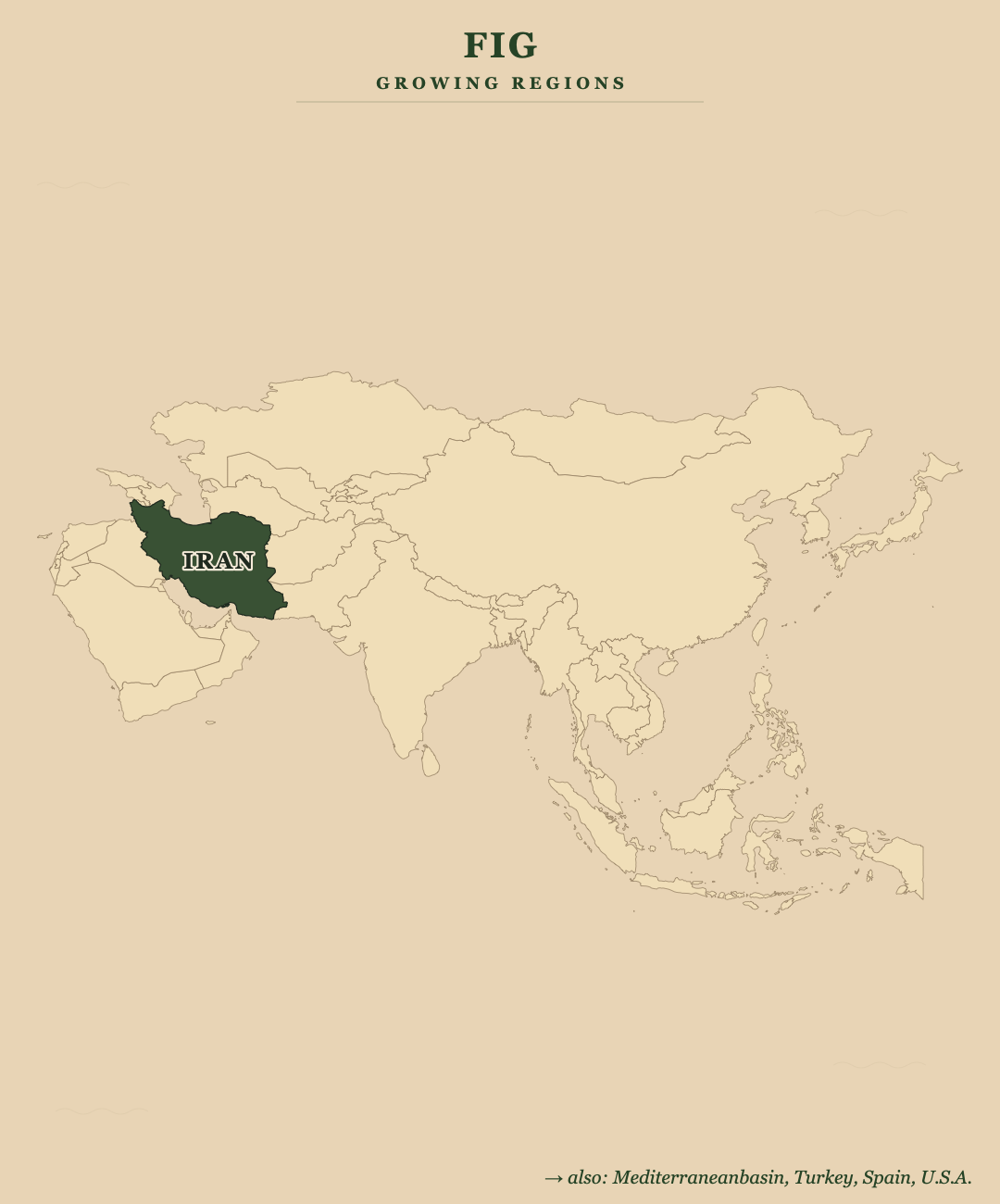
Fig is primarily cultivated in Mediterranean basin, Western Asia, with secondary growing regions in Turkey, Iran, California, southern Europe.
Spice Story
Few plants carry more history than the fig. It is one of the earliest plants humans ever domesticated: carbonised parthenocarpic figs from Gilgal I, in the Lower Jordan Valley, date to around 10,000 BCE — and their cultivation pre-dated the domestication of cereal crops by almost a thousand years. [source] Long before bread, then, there was the fig. It became one of the founding fruit trees of the ancient Mediterranean — olive, grape, date, pomegranate and fig, the quiet architecture of a whole civilisation's table. Its leaf has carried symbolic weight from Eden onward, and its scent has been chased by perfumers for centuries: a crushed-green, milky sap-note so prized that fig-leaf absolute was a perfumery staple until restricted in 2006 over the phototoxic psoralens in the leaf. [source] In gin, the fig brings that same double act — green leaf and jammy flesh.
Gin Creativity
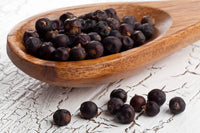
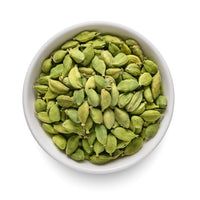
Fig is a rounding, sweetening botanical rather than a loud one. A full sachet pushes a gin toward soft, jammy, almost dessert-like richness with a green edge; a partial amount works behind the scenes, lengthening the finish and padding the mouthfeel. Because dried fig is gentle and sugary, it loves the spine of juniper and the warmth of cardamom and coriander seed — and a twist of lemon keeps it from turning cloying.
Blending Science
Main flavour compounds
 Hexanal—
 Benzaldehyde—
 (E)-2-Hexenal—
 Linaloolfloral, soft
Pairs well with
Fig fruit aroma is led by green C6 aldehydes — hexanal is the one constant, present at high levels across every cultivar and every stage of ripeness, carrying that fresh, fatty, leafy greenness. [source] (E)-2-hexenal sharpens the cut-leaf note and climbs steeply as the fruit ripens, while benzaldehyde lends the soft, sweet, marzipan-almond tone that reads as "ripe fig." [source] A whisper of linalool adds a floral-citrus lift and ranks among the genuinely odour-active compounds in dried figs. [source] Gentle, cool extraction protects these volatiles and the sugars; aggressive heat flattens the green top notes first.
Food Partners
- Soft and blue cheeses: the classic — fig's honeyed sweetness cuts salt and funk.
- Cured ham and prosciutto: sweet-savoury contrast that needs no improving.
- Honey and walnuts: echoes the fig's own sweet, faintly tannic, nutty register.
- Roast pork and game: jammy fig glaze against rich, fatty meat.
- Dark chocolate desserts: the marzipan-almond benzaldehyde note bridges beautifully to cocoa.
Cocktails To Try

- Fig Tuxedo: the dressed-up Martini variant of gin, dry vermouth, maraschino, a whisper of absinthe and orange bitters, built on a fig-forward gin — the fruit's jammy, almond-soft depth rounds the sharp edges into something autumnal and complex.
- Black Mission White Lady: the elegant gin, triple sec and lemon sour, given a fig syrup or muddled fig in place of some of the sugar — the green-and-honey character makes the whole drink feel softer and more grown-up.
- Fig & Bay Gin & It: the old-school classic of gin and sweet vermouth, stirred down with a fig-forward gin and a bruised bay leaf — the jammy fruit and the vermouth's herbs settle into a warm, after-dinner sipper.
Release The Flavour
- Heat: keep it low — cool or vacuum extraction protects the green top notes and the sugars; high heat flattens them.
- Alcohol: a good solvent for fig's jammy esters and sugars; macerate dried fig in your base spirit before distilling.
- Time: dried fig gives up its character slowly — allow a longer, gentle maceration than you would a citrus peel.
- Less is more: fig sweetens and rounds; use it to support juniper and spice, not to overwhelm them.
Discover more
From the same region
Pairs well with
Same flavour family

Surprise me

Sources & Citations
- scientific_name (Ficus carica L., Moraceae):GBIF Backbone Taxonomy, usageKey 5361909 (Ficus carica L....
- plant_form (deciduous tree/large shrub 7–10 m, smooth white bark, lobed leaves, Moraceae):en.wikipedia.org/wiki/Common_fig
- native_range (Mediterranean + western/southern Asia, sea level to ~1,700 m):en.wikipedia.org/wiki/Common_fig
- domestication (Gilgal I, Lower Jordan Valley, ~10,000 BCE; one of earliest domesticated plants; pre-dated cereal domestication):en.wikipedia.org/wiki/Domestication_of_Ficus_carica
- aroma_aldehyde_dominance (aldehydes 29–50% of VOCs; hexanal dominant across all cultivars/ripening; benzaldehyde abundant; (E)-2-hexenal rises with ripening; fruity+green descriptor):Comparative Study of Fig Volatile Compounds (HS-SPME-GC/M...
- linalool_OAV (linalool among key OAV≥1 aroma compounds in dried figs):Characterization of key aroma compounds in Xinjiang dried...
- green_note_Z3hexenal (green C6 leaf-aldehyde green note):pmc.ncbi.nlm.nih.gov/articles/PMC10867456/
- fig_leaf_perfumery (fig-leaf absolute IFRA-restricted 2006 over psoralen/furanocoumarin phototoxicity; modern fig notes synthetic):www.fragrantica.com/news/A-Fig-for-You-The-Scent-of-Fig-i...
- gin_conniption (Durham Distillery Conniption Navy Strength — dried figs cold vacuum-distilled and blended in):conniptiongin.com/products/conniption-navy-strength-gin
- gin_drumshanbo (The Shed Distillery — Drumshanbo Gunpowder Irish Gin Italian Fig & Laurel):www.thesheddistillery.com/
- compound_cids (PubChem):PubChem CIDs — hexanal 6184, benzaldehyde 240, (E)-2-hexenal 5281168, linalool 6549, (Z)-3-hexenal 643941
- hero_image:iStock royalty-free licence (asset 184874258)
