
SUMAC

- Botanical name
- Rhus coriaria
- Also known as
- Sumac berry, Sumakh (Arabic)
- Main flavour compound
- Malic acid
- Part used
- Dried, ground deep-red berries
- Method of cultivation
- Small shrub of the Anacardiaceae family (same family as cashew, mango and pistachio — and pink peppercorn). *Rhus coriaria* is native to southern Europe, the Mediterranean, the Middle East and Central Asia. The plant grows 2–3 metres tall with compound leaves and clusters of small deep-red berries that ripen in summer. Cultivation centres on Sicily, Turkey (the dominant commercial producer), Iran and parts of Central Asia.
- Commercial preparation
- Berries are picked when fully red, sun-dried, and ground into the characteristic deep-red powder. The brilliant colour and tart-lemon flavour come from natural malic acid and anthocyanin pigments. Some commercial sumac is salted; unsalted is preferred for distilling.
- Non-culinary uses
- Foundational ingredient in Middle Eastern cooking (especially za'atar blends, fattoush, on grilled meats); the leaves were historically used in leather tanning (the species name *coriaria* comes from Latin for "tanning"); natural fabric dye.
Sumac — Rhus coriaria — is a small shrub of the Anacardiaceae family (the same family as cashew, mango, pistachio and pink peppercorn), native to southern Europe, the Mediterranean, the Middle East and Central Asia. The plant grows 2–3 metres tall, with pinnately-compound leaves and clusters of small deep-red berries that ripen in summer. The leaves were historically used in tanning leather (the Latin species epithet coriaria means "of tanning"), but the berries are what the spice trade uses — providing the characteristic deep-red powder with sharp tart-lemon character. [source]
Ground (whole-berry quality)
The standard form — disperses quickly in cool maceration.
Whole dried berry
Less common; longer extraction.
Region of cultivation
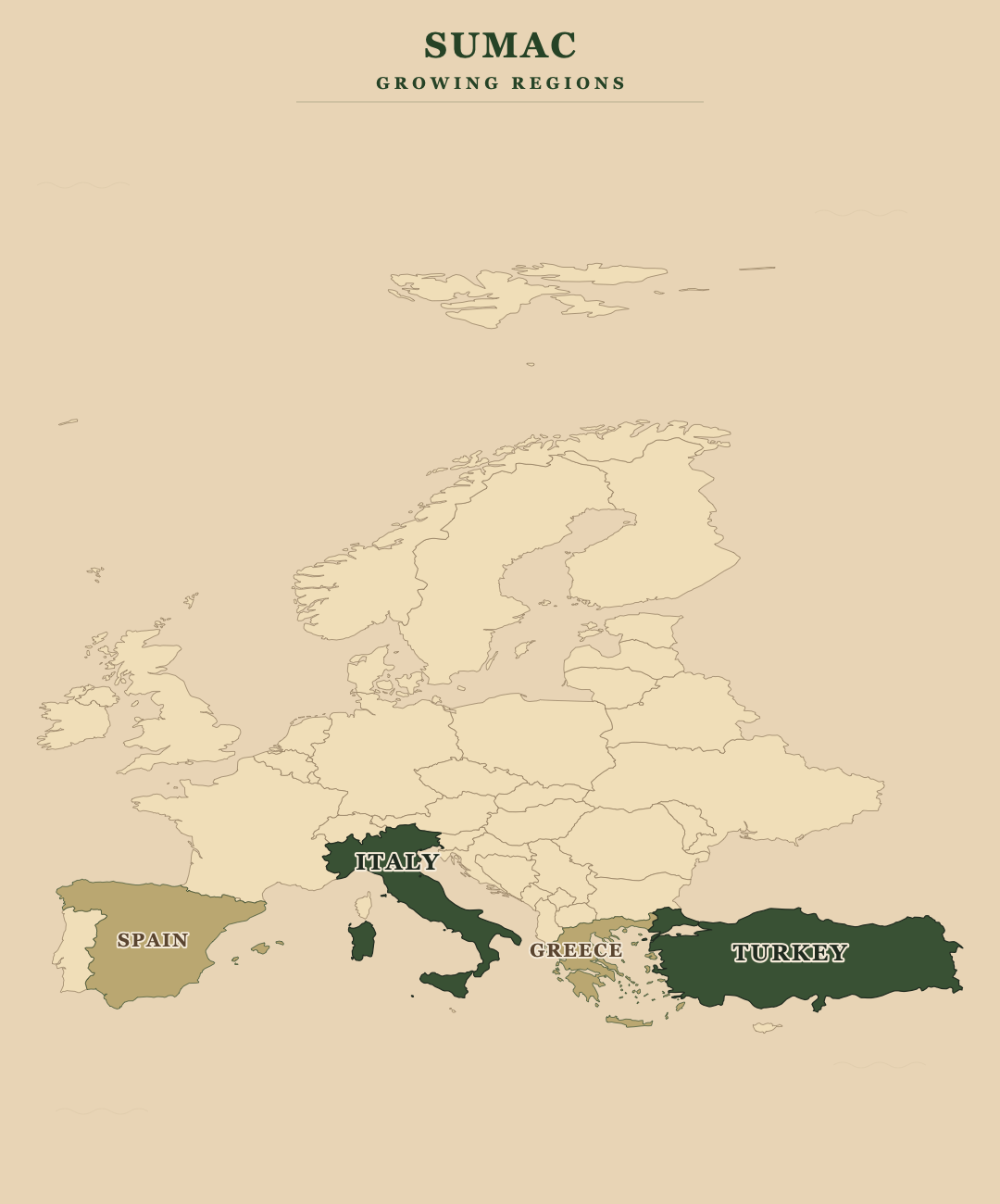
Sumac is primarily cultivated in Turkey (dominant), Iran, Sicily, Lebanon, Syria, with secondary growing regions in Spain, Greece, Morocco, Central Asia.
Spice Story
Sumac has been used as a souring agent in Middle Eastern, Mediterranean and Central Asian cooking since at least the 13th century — long before lemons became widely available in the region. It is foundational to za'atar (the Levantine spice blend), Lebanese fattoush (chopped salad), and is widely used on grilled meats across the Middle East. Modern global commercial production is dominated by Turkey, with Iran, Sicily and Lebanon as significant producers. In gin, sumac is an unusual contemporary botanical providing genuine tart-lemon character and a brilliant red visual signal.
Gin Creativity
Sumac brings tart-lemon-berry character with a quietly tannic edge. A full sachet pushes a gin into clearly Middle Eastern territory; a half-sachet provides bright tart depth that integrates with juniper. Pair with coriander seed and cumin for a Levantine profile, or with citrus peel and thyme for a Mediterranean blend.
Blending Science
Main flavour compounds
 Malic acid—
 Tannins—
 Anthocyanins—
Pairs well with
- Coriander seed
- Cumin
- Thyme
- Citrus peel
- Pomegranate
Malic acid is the dominant source of the tart flavour — the same compound that defines green apple's tartness. Tannins contribute astringent depth. Anthocyanins provide the brilliant red colour but are temperature-sensitive and pH-sensitive. Cool extraction preserves both the bright colour and the bright tartness; warm extraction can muddy the colour.
Food Partners
- Za'atar spice blends — sumac is a defining component.
- Fattoush salad — Lebanese tradition.
- Grilled meats — sumac on lamb kebabs, chicken shawarma.
- Roast vegetables — sumac on roasted carrots and beetroot.
- Hummus and tahini-based dishes — sumac dusting.
Cocktails To Try

- Levantine Sour — sumac gin, pomegranate, lemon, egg white.
- Middle Eastern G&T — sumac gin, tonic, fresh za'atar garnish.
- Sumac Spritz — sumac gin, prosecco, soda.
Release The Flavour
- Cool extraction — preserves bright colour and tart character.
- Brief contact — 1–4 hours.
- Strain finely — fine powder can cloud the spirit.
- Verify unsalted — some commercial sumac is salted.
Discover more
From the same region
Pairs well with
Same flavour family
Surprise me

Sources & Citations
- scientific_name (Rhus coriaria, Anacardiaceae):en.wikipedia.org/wiki/Sumac
- mediterranean_middle_eastern_origin:en.jardineriaon.com/rhus-coriaria.html
- turkey_dominant_producer:flaevor.com/sumac/
- malic_acid_tartness:allspiceonline.com/blogs/news/spotlight-spice-sumac
- leather_tanning_etymology:en.wikipedia.org/wiki/Sumac
- main_flavour_compounds (CSV-sourced):inputs/source.csv — Sumac row
