
NIAOULI

- Botanical name
- Melaleuca quinquenervia (high-cineole chemotype)
- Also known as
- Broad-leaved Paperbark, Niaouli (the cineole-rich commercial chemotype)
- Main flavour compound
- 1,8-Cineole
- Part used
- Dried leaf
- Method of cultivation
- Same species as Nerolina (*Melaleuca quinquenervia*) — but the Niaouli chemotype is specifically the high-cineole variety, primarily cultivated in New Caledonia and Madagascar (where the tree was introduced and has become a major commercial crop). The plant grows quickly and aggressively, producing dense canopies that allow regular harvest of leaves and small branches for steam distillation.
- Commercial preparation
- Leaves, twigs and small branches are harvested and steam-distilled. The principal chemovar found in New Caledonia is the 1,8-cineole variety used for commercial Niaouli oil; Madagascar production has expanded significantly. The Niaouli oil's high cineole content gives it a noticeably medicinal character distinct from the floral Nerolina chemotype.
- Non-culinary uses
- Foundational essential oil in New Caledonian and Madagascan natural-medicine traditions — used as decoctions and poultices for infections; the Kanak peoples of New Caledonia have a long tradition of medicinal use; modern aromatherapy and natural cosmetics.
Niaouli is the commercial high-cineole chemotype of Melaleuca quinquenervia — the same Broad-leaved Paperbark tree that is also commercially produced as the high-linalool Nerolina chemotype. The tree is native to the eastern Australian coast (Sydney to Cape York), with naturalised and introduced populations in New Caledonia, Madagascar, parts of New Guinea and (where it has become a significant invasive) parts of Florida and South Asia. [source] Most commercial Niaouli oil is now produced in New Caledonia and Madagascar; the chemotype there is dominated by 1,8-cineole.
Whole dried leaf
Crumble lightly to release the cineole.
Cracked
Faster extraction.
Region of cultivation
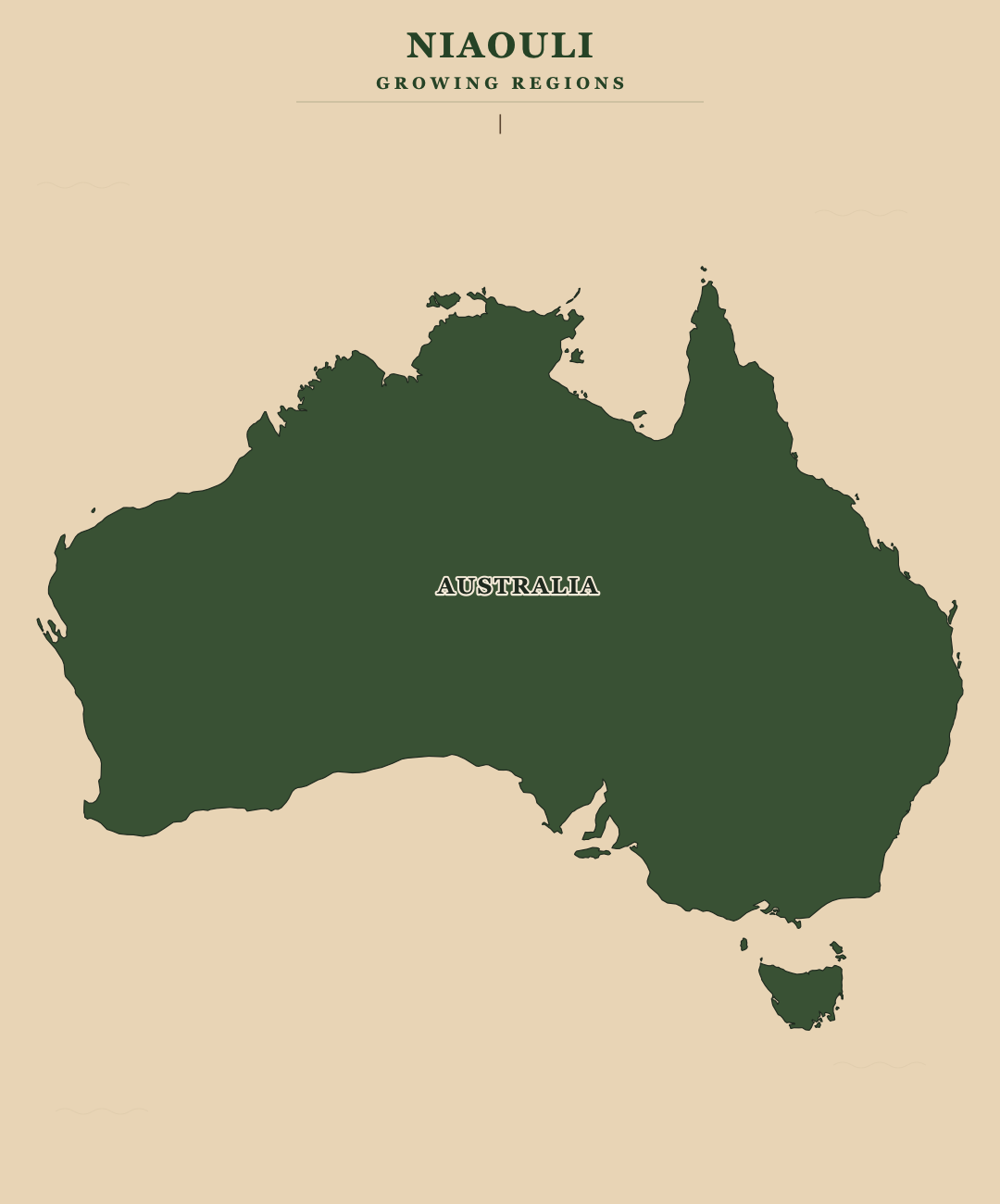
Niaouli is native to Australia, Australia (native — eastern coast); New Caledonia and Madagascar (commercial cultivation), with secondary growing regions in Australia is the native origin, but most commercial Niaouli oil is now produced in New Caledonia and Madagascar. |
Spice Story
Niaouli has been used in Kanak (Indigenous New Caledonian) traditional medicine for centuries — decoctions and poultices made from the leaves are used to treat infections and accelerate wound healing. [source] The species' status as a medicinal essential-oil crop in New Caledonia and Madagascar was reinforced during the French colonial period, and the Niaouli oil has been a significant commercial product since the early 20th century. In gin, Niaouli is an unusual contemporary botanical, providing clean eucalypt-cineole character distinct from imported eucalyptus oil.
Gin Creativity
Niaouli brings clean cool-eucalypt character with less medicinal weight than common tea tree. A full sachet pushes a gin firmly into cineole-medicinal territory; a half-sachet provides cool eucalypt freshness that integrates with juniper. Pair with Lemon Myrtle for citrus lift, or with Pepperberry for spice contrast.
Blending Science
Main flavour compounds
 1,8-Cineoleeucalyptus, cool
 Alpha-Pinenefresh pine, top note
 Viridiflorol—
 Linaloolfloral, soft
Pairs well with
1,8-Cineole dominates the high-cineole chemotype — the same compound that defines eucalyptus oil but in different supporting context. Alpha-pinene provides a resinous backbone. Viridiflorol is a sesquiterpene alcohol contributing sweet woody depth (and an unusual compound that's relatively rare in other essential oils). Linalool adds a soft floral lift. Heat-stable; both vapour and warm maceration work.
Food Partners
- Bush spice rubs for game meat.
- Smoked meats — Niaouli's cool freshness supports smoke.
- Roast root vegetables — Niaouli-gin glaze.
- Eucalypt honey desserts — natural pairing.
- Aged cheese — Niaouli gin in cheese reductions.
Cocktails To Try

- Eucalypt G&T — Niaouli gin, native tonic, fresh eucalypt garnish.
- Bush Negroni — Niaouli and pepperberry gin, Campari, vermouth.
- Cool Sour — Niaouli gin, lemon, honey, egg white.
Release The Flavour
- Crumble gently — exposes the cineole.
- Heat-friendly — both vapour and warm maceration work.
- Source matters — New Caledonian production is the historic premium grade.
- Less is more — cineole-heavy botanicals dominate quickly.
Discover more
Pairs well with
Same flavour family
Surprise me

Sources & Citations
- scientific_name (Melaleuca quinquenervia, Myrtaceae):www.boemia-aroma.com/en/niaouli-essential-oil-the-hidden-...
- native_to_australia_PNG_new_caledonia:www.boemia-aroma.com/en/niaouli-essential-oil-the-hidden-...
- commercial_production_new_caledonia_madagascar:www.boemia-aroma.com/en/niaouli-essential-oil-the-hidden-...
- high_cineole_chemotype:www.boemia-aroma.com/en/niaouli-essential-oil-the-hidden-...
- kanak_traditional_medicinal_use:www.boemia-aroma.com/en/niaouli-essential-oil-the-hidden-...
- main_flavour_compounds (CSV-sourced):inputs/source.csv — Niaouli row
