
LEMON VERBENA

- Botanical name
- Aloysia citrodora (also Aloysia triphylla)
- Also known as
- Herb Louisa, Hierba Luisa, Verveine citronnelle, Lemon beebrush
- Main flavour compound
- Citral (neral + geranial — high concentration)
- Part used
- Dried leaf
- Method of cultivation
- Deciduous flowering perennial of the Verbenaceae family, native to South America — particularly Argentina, Chile, Peru and Uruguay. The plant grows 1–3 metres tall, with long lance-shaped leaves that release an intense crystalline-lemon aroma when bruised — brighter and cleaner than lemon balm or lemon thyme. Modern cultivation centres on France (Provence), Spain, Morocco and South America.
- Commercial preparation
- Leaves are harvested in summer at peak aromatic content, gently dried at low temperature to preserve the volatile citral, and either sold whole or steam-distilled for essential oil. The leaf is fragile and can lose character quickly if poorly dried or stored.
- Non-culinary uses
- Foundational ingredient in French *verveine* tisanes (still widely drunk in France); perfumery (sometimes called "the queen of lemons" in the fragrance trade); traditional South American medicine for digestion and anxiety; Vichy water and French herbal-tea tradition.
Lemon Verbena — Aloysia citrodora — is a deciduous flowering perennial of the Verbenaceae family, native to South America. The plant grows 1–3 metres tall, with long pointed lance-shaped leaves that emit an intense, almost crystalline lemon scent when bruised — significantly brighter than lemon balm and cleaner than lemon thyme. [source] The Latin species name citrodora means "lemon-scented." The genus Aloysia was named in honour of Maria Luisa Teresa of Parma (1751–1819), wife of King Charles IV of Spain, who grew the plant in the royal garden at Madrid — hence the alternative common name "Herb Louisa."
Whole dried leaf
The standard form — crumble gently to release the citral.
Cracked
Faster extraction.
Region of cultivation
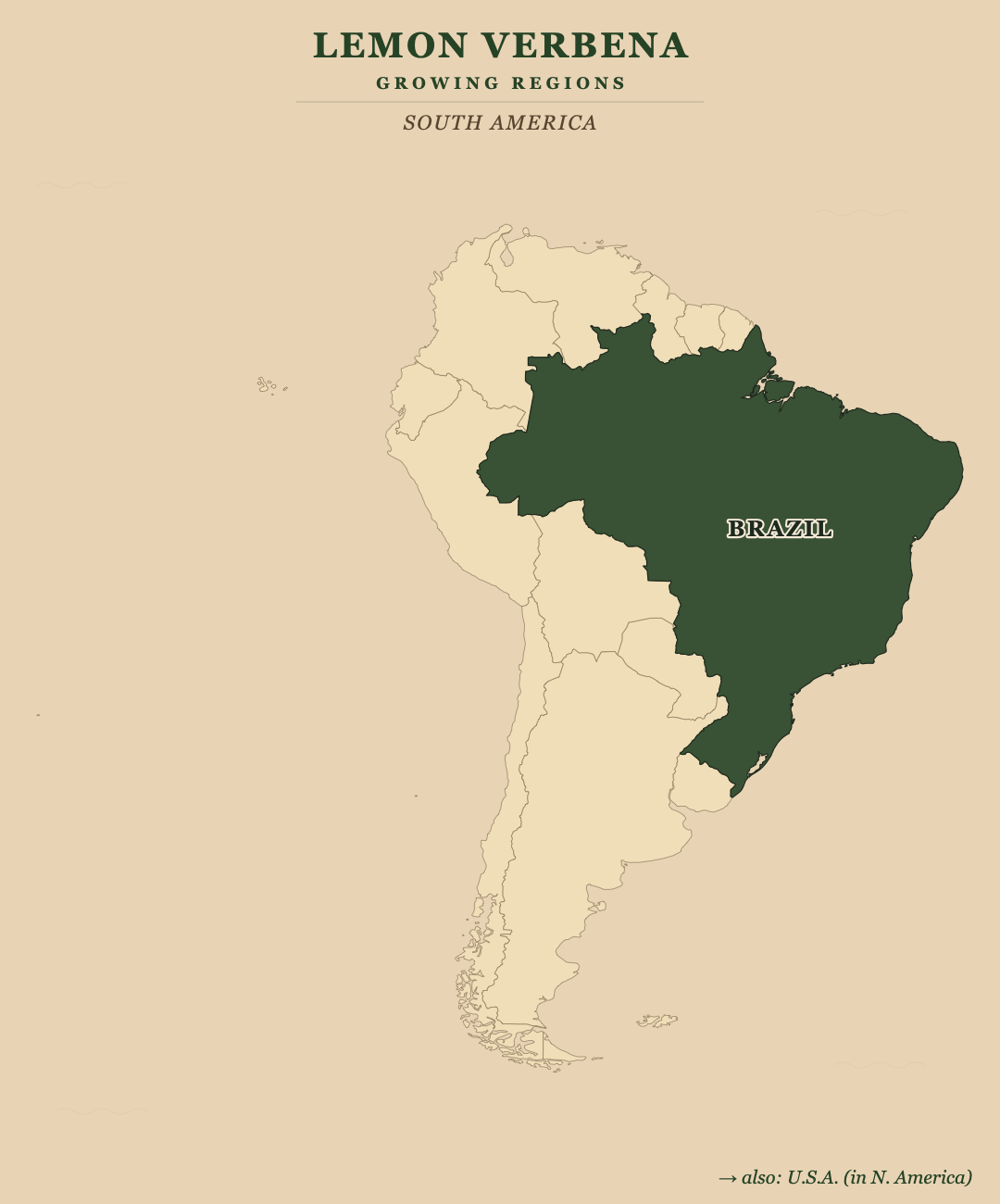
Lemon Verbena is primarily cultivated in South America (Argentina, Chile, Peru, Uruguay) — native; France, Spain, Morocco — major cultivation, with secondary growing regions in USA, Australia (small-scale).
Spice Story
Lemon Verbena was cultivated and used by the Inca peoples of pre-Columbian South America for cooking and traditional medicine; archaeological evidence places it in Andean cooking and herbal medicine for hundreds of years. [source] Spanish and Portuguese traders brought it to Europe in the 17th century, where it was initially cultivated for its essential oil; later it fell from commercial significance as the cheaper lemongrass (Cymbopogon citratus) became dominant. Lemon verbena remains foundational to French verveine tisane culture and is increasingly important in fine perfumery (sometimes called "the queen of lemons"). In gin, lemon verbena provides the cleanest, most crystalline lemon-herb character of any common botanical.
Gin Creativity
Lemon Verbena brings crystalline lemon brightness with a herbaceous edge — cleaner than direct lemon peel, sweeter than lemon thyme. A full sachet pushes a gin into clearly lemon-herb territory; a half-sachet provides a quiet lemon lift that integrates with juniper. Pair with lemon balm and chamomile for a French-style tisane profile, or with bergamot and honey for a Mediterranean lemon-floral blend.
Blending Science
Main flavour compounds
 Citral (neral + geranial — high concentration)lemon-bright
 Limoneneclean citrus lift
 Linaloolfloral, soft
 Geraniolrose, soft floral
Pairs well with
Citral dominates the leaf oil at high concentration, providing the bright lemon character. Limonene layers a citrus brightness. Linalool adds a soft floral lift familiar from coriander and lavender. Geraniol contributes a rose-citrus depth. Cool extraction preserves the bright citral; warm extraction develops a softer character but at the cost of brightness.
Food Partners
- Fresh seafood — verbena and grilled white fish.
- Lemon-and-honey desserts — lemon verbena ice cream is a chef's classic.
- Stone-fruit jams — apricot and lemon verbena preserves.
- Cool sorbets and ice creams — pristine lemon-herb character.
- French-style tisane biscuits — verveine and honey shortbread.
Cocktails To Try

- Lemon Verbena Gimlet — verbena gin, lime cordial, fresh verbena leaf.
- French 75 (verbena) — verbena gin, champagne, lemon, sugar.
- Garden Spritz — verbena gin, prosecco, soda, fresh leaf garnish.
Release The Flavour
- Cool extraction — preserves the citral.
- Crumble gently — the leaf is delicate.
- Brief contact — 1–4 hours captures the brightness.
- Source matters — French Provençal verbena is the premium grade.
Discover more
From the same region
Pairs well with
Same flavour family
Surprise me

Sources & Citations
- scientific_name (Aloysia citrodora, Verbenaceae):en.wikipedia.org/wiki/Aloysia_citrodora
- south_american_native_range:en.wikipedia.org/wiki/Aloysia_citrodora
- inca_traditional_use:gardenish.co/plants/aloysia-citrodora
- 17th_century_spanish_portuguese_introduction_to_europe:gardenish.co/plants/aloysia-citrodora
- maria_luisa_teresa_naming (Aloysia):gardenish.co/plants/aloysia-citrodora
- brightness_compared_to_lemon_balm_lemon_thyme:en.wikipedia.org/wiki/Aloysia_citrodora
- main_flavour_compounds (CSV-sourced):inputs/source.csv — Lemon Verbena row
