
KELP

- Botanical name
- Ecklonia radiata
- Also known as
- Golden Kelp, Common Kelp, Spiny Kelp, Leather Kelp
- Main flavour compound
- Glutamic acid (free glutamate)
- Part used
- Frond / thallus (dried blade)
- Method of cultivation
- A brown alga (not a plant — it has no roots, stem or leaves), Ecklonia radiata anchors to rocky temperate reef by a holdfast and rarely exceeds about 1 metre in length. It is overwhelmingly wild-harvested by hand-foraging or beach-cast collection from the low intertidal down to roughly 25 metres; it is also an emerging aquaculture target.
- Commercial preparation
- Harvested fronds are rinsed of salt and sand, then dried (sun- or low-temperature dried) and milled into flakes or powder, or kept as whole dried blades. Drying concentrates the free glutamate and mineral salts that carry kelp's savoury, briny character.
- Non-culinary uses
- Major source of alginate (a gelling/thickening polysaccharide for food, pharmaceuticals and cosmetics) and of fucoidan and phlorotannins for nutraceuticals; also used as a soil and plant biostimulant.
Let's be precise: kelp isn't a plant at all. Ecklonia radiata — golden or common kelp — is a brown alga, with no roots, stem or leaves; instead a grippy holdfast clamps it to rocky reef while a leathery, golden-brown frond fans out in the surge. It rarely tops a metre, yet where the water is sheltered it gathers into dense underwater forests from the low-tide line down to about 25 metres. [source] It is the backbone of Australia's Great Southern Reef. [source]
Whole dried blade
Snap into a botanical basket for a clean briny-umami lift; rinse first if heavily salted.
Flakes or powder
Faster, stronger extraction — easy to over-salt a small batch, so dose lightly.
Region of cultivation
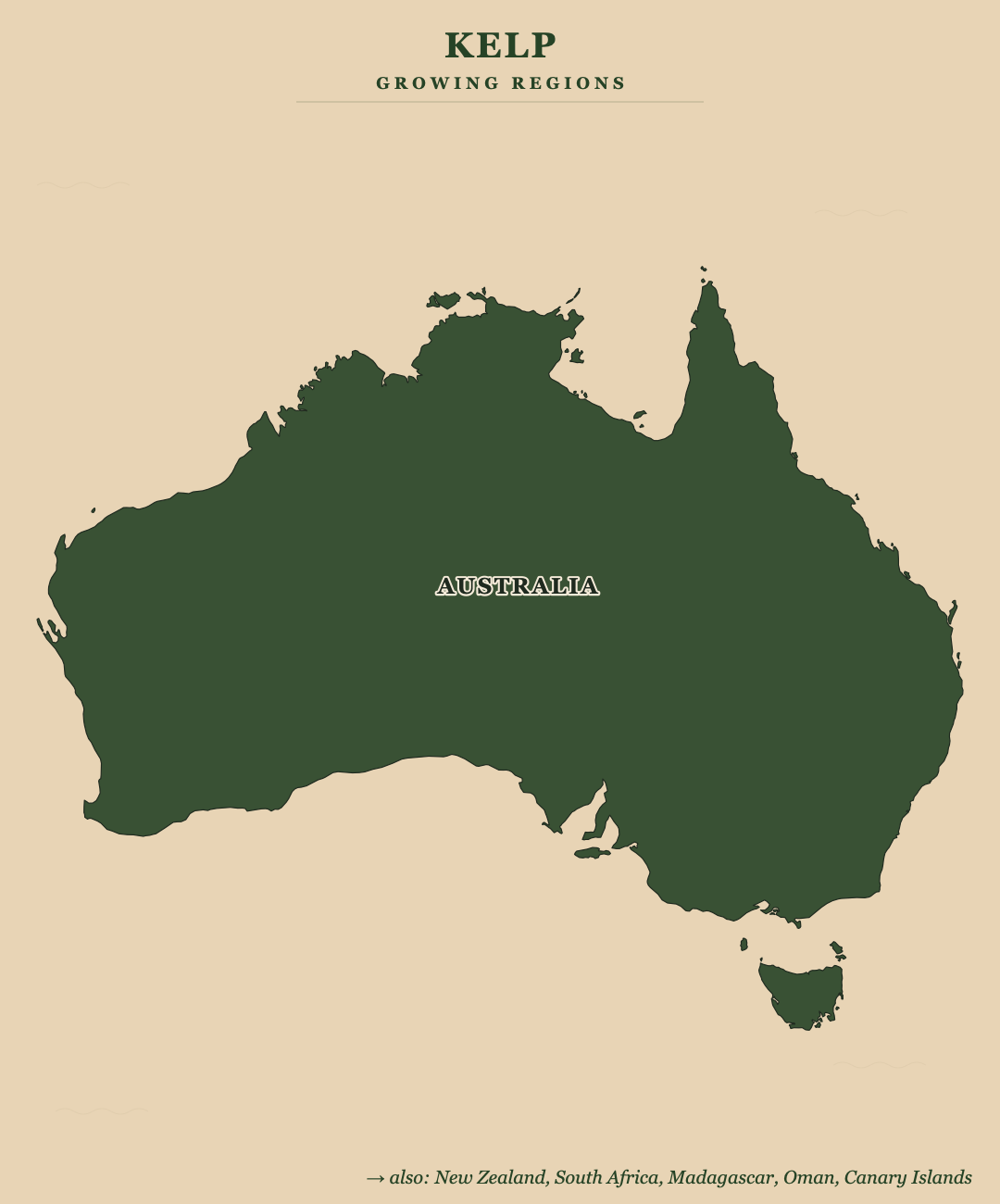
Kelp is primarily cultivated in Australia, New Zealand, with secondary growing regions in South Africa, Oman, Canary Islands, Madagascar.
Spice Story
Kelp's story isn't one of caravans and spice ports — it's the taste of the sea itself, and it sits at the very origin of a flavour science. In 1908 the chemist Kikunae Ikeda, puzzling over why a simple kombu (kelp) broth tasted so deeply savoury, isolated glutamic acid from the dried blade and gave the sensation a name: umami, the fifth taste. [source] Kelp remains the richest natural larder of free glutamate we know — dried kombu carries on the order of 1,200 to 3,400 mg per 100 g, depending on variety. [source] Today Ecklonia radiata is foraged from the temperate reefs of Australia, New Zealand and southern Africa, and a clutch of coastal distillers have begun treating it as a botanical — a way of bottling the briny, mineral character of their own shoreline. [source]
Gin Creativity
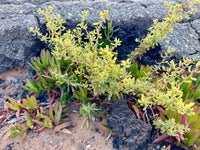
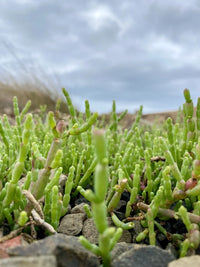
Kelp is a taste botanical, not a perfume. It brings savoury umami depth, a clean mineral salinity and a faint marine "sea-note" rather than a fragrant top note — so treat it as seasoning, not as your aromatic lead. A full sachet pushes a gin firmly maritime and briny; a partial dose is usually wiser, adding a saline, savoury backbone beneath the juniper. Pair it with Samphire and Saltbush for a true coastal gin, or let Lemon Myrtle and Coriander Seed lift it with brightness.
Blending Science
Main flavour compounds
 Glutamic acid (free glutamate)—
 Mannitol—
 Iodine & mineral salts—
 Dimethyl sulfide (DMS)—
Pairs well with
Kelp works on the tongue more than the nose. Free glutamate delivers the umami — the same compound Ikeda named in 1908 — giving a gin savoury weight and length. [source] Mannitol, the white "bloom" on a dried blade, adds a faint sweetness, while iodine and mineral salts (iodine alone runs 0.34–1.06% of dry weight) carry the clean briny salinity. [source] The one genuine aroma is dimethyl sulfide, the volatile responsible for the actual "scent of the sea." [source] These are water- and salt-soluble, so a vapour basket gives a cleaner, more delicate result than a heavy boil, which can turn cabbagey.
Food Partners
- Oysters and raw shellfish: kelp's briny umami amplifies the sea-sweetness of the shellfish.
- Sashimi and sushi: a saline, savoury seasoning that sits naturally with raw fish and rice.
- Dashi-based broths: kelp IS the umami foundation of dashi — a natural home.
- Cured and smoked fish: glutamate depth complements the salt and smoke.
- Cucumber and citrus: clean, cool foils that lighten kelp's mineral weight.
Cocktails To Try

- Oceanic Dirty Martini: a kelp gin stirred very cold with dry vermouth and a measure of olive brine — the leaf's saline umami stacks onto the brine for a martini that tastes properly of the sea.
- Kelp Gibson: the dry Martini's cousin, garnished with a pickled onion instead of an olive — the kelp's mineral, briny depth turns the savoury-sharp Gibson into something genuinely coastal.
- Seaside Red Snapper: the gin answer to a Bloody Mary, built with a kelp gin, tomato, lemon and spice — the umami glutamate deepens the savoury tomato into a long, oceanic brunch serve.
Release The Flavour
- Heat: keep it gentle — a vapour basket or light infusion preserves the clean briny note; a hard boil can turn it cabbagey (that's the DMS).
- Alcohol: glutamate and mineral salts are water- and salt-soluble rather than spirit-loving, so don't over-rely on a high-proof soak.
- Time: short contact is enough; long maceration mostly just adds salt and risks bitterness from phlorotannins.
- Less is more: kelp is concentrated salinity and umami — dose lightly and taste, especially with flakes or powder.
Discover more
From the same region
Pairs well with
Surprise me

Sources & Citations
- scientific_name (Ecklonia radiata, Lessoniaceae, brown alga):GBIF Backbone Taxonomy, usageKey 3196095 (Ecklonia radiata (C.Agardh) J.Agardh, ACCEPTED, kingdom Chromista)
- morphology (brown alga, holdfast, ~1 m, intertidal–25 m, forms forests):en.wikipedia.org/wiki/Ecklonia_radiata
- distribution (Australia, NZ, South Africa, Oman, Canary Is, Madagascar; Great Southern Reef backbone):en.wikipedia.org/wiki/Ecklonia_radiata
- composition (alginate 16.6–22.7% DW, iodine 0.34–1.06% DW, ash 16.2–29.0% DW, protein 4.6–8.6% DW, phlorotannins 4.8–12.4% DW):High spatial and temporal variation in biomass compositio...
- storage_polysaccharides (alginic acid, mannitol, laminarin, fucoidin present in Ecklonia radiata):Seasonal Variation in Alginic Acid, Mannitol, Laminarin a...
- glutamate_umami (kelp/kombu is the highest natural free-glutamate food; ~1,200–3,400 mg/100g dried kombu):Umami Information Center — Kombu; www.umamiinfo.com/richf...
- umami_history (Ikeda isolated L-glutamic acid from kombu, naming umami in 1908):Seaweeds for umami flavour in the New Nordic Cuisine, Fla...
- dms_sea_note (dimethyl sulfide from DMSP in brown algae is the principal 'scent of the sea'):Compound Interest — The chemical compounds behind the sce...
- gin_bass_and_flinders_maritime (kelp + samphire + saltbush, Mornington Peninsula):www.bassandflindersdistillery.com/products/maritime-gin-7...
- gin_isle_of_harris (sugar kelp Saccharina latissima — different species; cited as the famous coastal-kelp gin, not Ecklonia):harrisdistillery.com/pages/isle-of-harris-gin
- pubchem_cids (glutamic acid 33032, mannitol 6251, iodine 807, dimethyl sulfide 1068):PubChem — CID lookups: 33032 (L-glutamic acid), 6251 (D-mannitol), 807 (iodine), 1068 (dimethyl sulfide)
- hero_image:iStock royalty-free licence (asset 157169408)
