
EUCALYPTUS LEMON SCENTED IRONBARK

- Botanical name
- Eucalyptus staigeriana
- Also known as
- Lemon-scented Ironbark, LSIB, Lemon Ironbark, Eucalyptus Lemon Ironbark
- Main flavour compound
- 1,8-Cineole (~35%)
- Part used
- Dried leaf
- Method of cultivation
- Small ironbark tree of the Myrtaceae family, endemic to a tightly restricted range in the Palmer River area of Cape York Peninsula in far north Queensland — the Maytown–Palmer River–Maitland Downs hill country. The species reaches around 12 metres tall, forms a lignotuber (and so coppices well after cutting), and prefers full sun on well-drained soil. Unusual among eucalypts for combining strong citral content (giving it a clear lemon character) with the more typical cineole eucalypt backbone.
- Commercial preparation
- Leaves are harvested from cultivated plantation or sustainable wild stands, gently dried, and either sold whole for distilling or steam-distilled for essential oil. Fresh leaves yield 2.9–3.4% essential oil — high by eucalypt standards.
- Non-culinary uses
- Essential oil for flavouring, perfumery and aromatherapy; the lemon-and-eucalypt character makes it particularly useful in fragrance work; insect repellent applications.
Eucalyptus Lemon Scented Ironbark — Eucalyptus staigeriana, often abbreviated as LSIB — is a small ironbark tree of the Myrtaceae family, endemic to a remarkably small native range in far north Queensland: the Palmer River, Maytown and Maitland Downs hill country of Cape York Peninsula. [source] The species grows to about 12 metres with a distinctive dark, deeply-furrowed ironbark trunk. What makes LSIB botanically interesting is its essential oil chemistry: unlike most eucalypts, which are dominated by 1,8-cineole, LSIB combines moderate cineole (around 35%) with substantial citral content (neral and geranial together, around 22%) plus geraniol and nerol — giving the oil a distinctly lemon-and-eucalypt character that no other commercial eucalypt matches.
Whole dried leaf
The standard form — crumble lightly to expose oils.
Cracked leaf
Faster extraction.
Region of cultivation
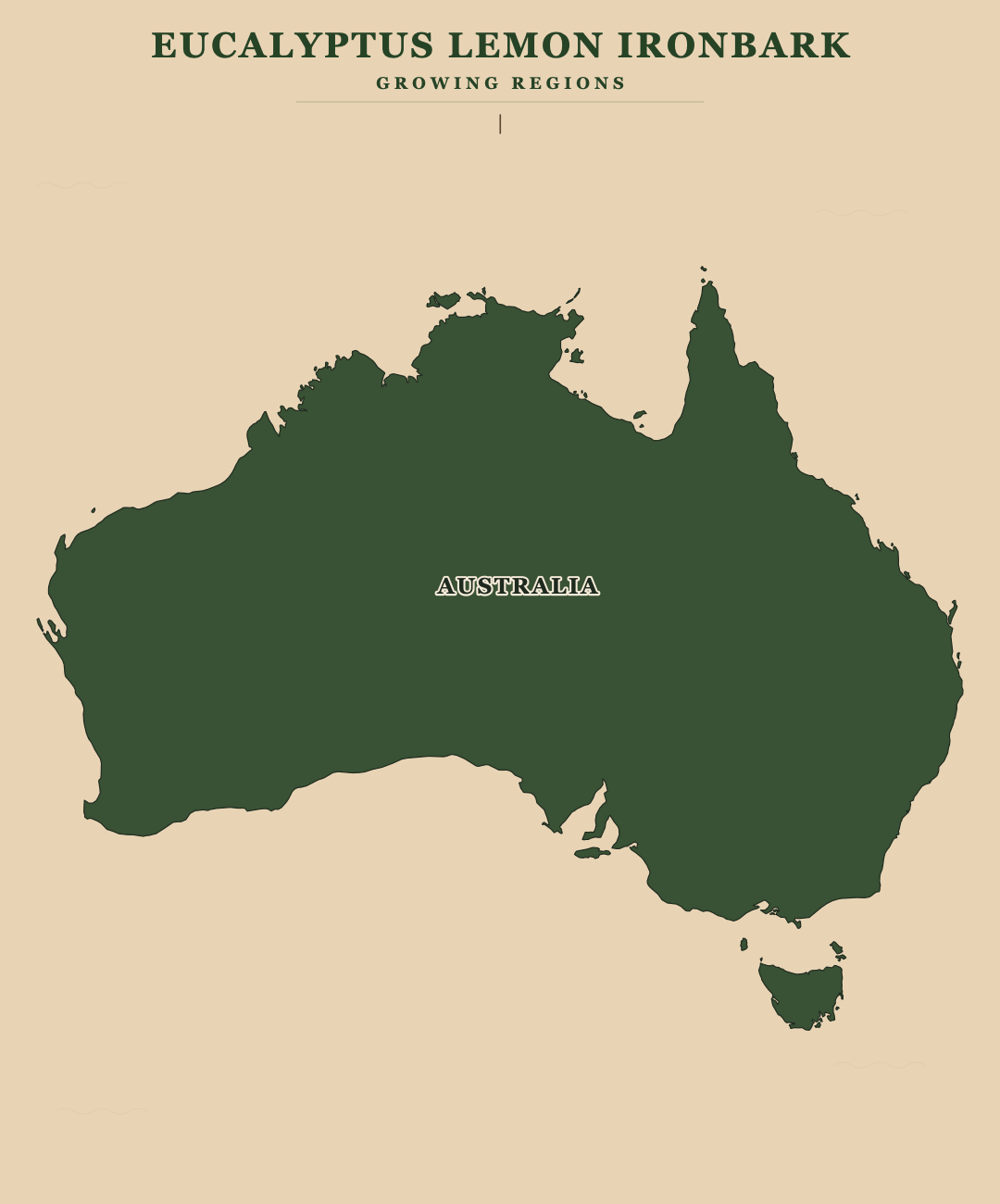
Eucalyptus Lemon Scented Ironbark is native to Australia, Australia — Cape York Peninsula, Queensland (Palmer River, Maytown, Maitland Downs), with secondary growing regions in Limited plantation cultivation in northern Queensland. |
Spice Story
LSIB is one of a small handful of native Australian eucalypts that have moved from regional curiosity to commercial essential-oil production in the past few decades. The narrow native range — restricted to one geological pocket of Cape York — means commercial supply depends on small plantation operations, and LSIB remains less widely available than the more widely-distributed blue mallee or blue gum. Its dual character (eucalypt-and-lemon) makes it particularly valuable in fragrance and flavour work, and it has begun to appear in Australian craft gin where distillers want both eucalypt and citrus character from a single botanical.
Gin Creativity
LSIB is one of the most distinctive Australian botanicals available — pushing a gin into clearly lemon-eucalypt territory in a way no other single ingredient can. A full sachet creates an explicitly native lemon-eucalypt gin; a half-sachet adds a quietly complex aromatic that integrates with juniper. Pairs particularly well with lemon myrtle (citral-on-citral, doubled brightness) or with pepperberry and native lemongrass for a bush-spice profile. Avoid pairing with very heavy florals — LSIB's citrus brightness gets buried.
Blending Science
Main flavour compounds
 1,8-Cineole (~35%)eucalyptus, cool
 Neral (~11%)—
 Geranial (~11%)—
 Alpha-Phellandrenecitrus-mint, peppery
 Methyl Geranate—
Pairs well with
The dual-character chemistry is what distinguishes LSIB from other eucalypts. 1,8-Cineole (about 35%) provides the cool eucalypt backbone. Neral and geranial (together about 22%) — the two isomers of citral — provide the bright lemon character. Alpha-phellandrene (about 9%) adds green-herbaceous depth. Methyl geranate layers a sweet floral lift. [source] The citral is the more heat-sensitive component; cool extraction preserves the lemon brightness, while warm extraction emphasises the cineole and the methyl geranate floral notes.
Food Partners
- Lemon-glazed fish — LSIB in a finishing reduction over grilled white fish.
- Native bush spice rubs — LSIB and pepperberry on grilled red meat.
- Roasted root vegetables — gives a Lemon-eucalypt edge to roast parsnip and carrot.
- Lemon-and-eucalypt desserts — lemon ice cream with LSIB syrup.
- Sparkling water and natural tonics — LSIB-gin in a refreshing summer long drink.
Cocktails To Try

- Australian G&T — LSIB gin, native tonic, fresh lemon-myrtle leaf garnish.
- Native Gimlet — LSIB gin, lime cordial, native-lime peel.
- Lemon-eucalypt Spritz — LSIB gin, prosecco, soda, lemon zest.
Release The Flavour
- Cool extraction — preserves the bright citral lemon character.
- Crumble gently — exposes the oils without bitterness.
- Source matters — genuine Cape York-origin LSIB has more citral than plantation production.
- Time — short extractions favour the lemon top; longer extractions develop the cineole body.
Discover more
Pairs well with
Same flavour family
Surprise me

Sources & Citations
- scientific_name (Eucalyptus staigeriana, Myrtaceae):en.wikipedia.org/wiki/Eucalyptus_staigeriana
- native_range (Palmer River area, Cape York, Queensland):en.wikipedia.org/wiki/Eucalyptus_staigeriana
- oil_chemistry (1,8-cineole 34.8%, neral 10.8%, geranial 10.8%):en.wikipedia.org/wiki/Eucalyptus_staigeriana
- leaf_oil_yield (2.9-3.4%):en.wikipedia.org/wiki/Eucalyptus_staigeriana
- main_flavour_compounds (CSV-sourced):inputs/source.csv — Eucalyptus Lemon Scented Ironbark row
