
SENCHA

- Botanical name
- Camellia sinensis (Yabukita and other Japanese cultivars)
- Also known as
- Japanese green tea, Fukamushi sencha (deep-steamed variant)
- Main flavour compound
- L-Theanine (umami)
- Part used
- Dried sun-grown green tea leaves (unlike matcha, which is shade-grown)
- Method of cultivation
- Sencha is the everyday Japanese green tea, made from sun-grown *Camellia sinensis* leaves (in contrast to the shade-grown leaves used for matcha and gyokuro). Most commercial sencha uses the Yabukita cultivar — the dominant Japanese tea cultivar. Shizuoka prefecture produces approximately 36–40% of all Japanese green tea, making it the country's largest tea-producing region; Uji (Kyoto), Kagoshima and Sayama are the other major regions. The volcanic ash deposits from Mount Fuji create the mineral-rich slightly-acidic soil that defines Shizuoka tea terroir.
- Commercial preparation
- Fresh leaves are picked, briefly steamed (the defining Japanese-style processing — unlike Chinese pan-fired greens), rolled to give them the characteristic needle shape, and dried. Steaming preserves the green colour and prevents oxidation. "Fukamushi sencha" is a deep-steamed variant with broken leaves and a stronger flavour.
- Non-culinary uses
- The most consumed tea in Japan; foundational to Japanese tea culture (alongside ceremonial matcha); cosmetics (green tea catechins are foundational antioxidant compounds in natural skincare).
Sencha is the everyday Japanese green tea — made from sun-grown leaves of Camellia sinensis, in contrast to the shade-grown leaves used for matcha and gyokuro. Most commercial sencha uses the Yabukita cultivar, the dominant Japanese tea variety. [source] Shizuoka prefecture (with its Mount Fuji-derived volcanic ash soil) produces around 40% of all Japanese green tea; Uji in Kyoto, Kagoshima, and Sayama (Saitama) are the other major regions.
Loose-leaf sencha
The standard form — distinctive dark-green needle-shaped leaves.
Tea-bag form
Convenient but typically uses lower grades.
Region of cultivation
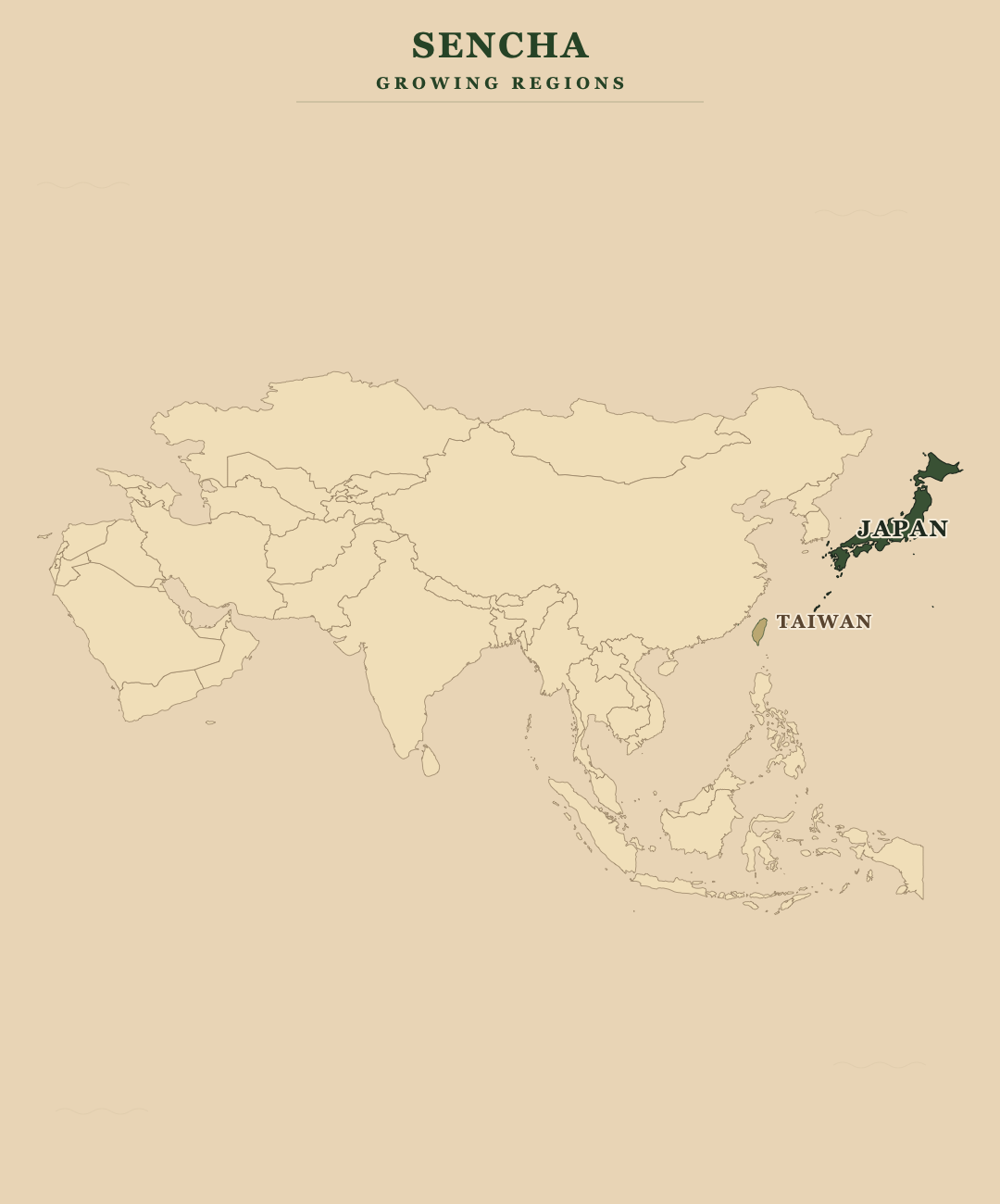
Sencha is primarily cultivated in Japan — Shizuoka (40% of production), Uji (Kyoto), Kagoshima, with secondary growing regions in Sayama (Saitama), small specialty production in Taiwan and Korea.
Spice Story
Tea cultivation in Japan began in the 12th century when Zen monks returned from China with seedlings and the practice of brewing green tea. Sencha specifically emerged in the 18th century as a more accessible, everyday alternative to ceremonial matcha — and has since become the most consumed tea in Japan, foundational to daily Japanese life. The Japanese steaming processing technique (rather than the Chinese pan-firing method) preserves chlorophyll and produces the characteristic deep green colour and umami-vegetal flavour. In gin, sencha provides a clean green-tea character similar to matcha but lighter, less concentrated, and easier to integrate with juniper.
Gin Creativity
Sencha brings clean grassy-umami character without the concentrated intensity of matcha. A full sachet pushes a gin into clearly green-tea territory; a half-sachet provides quiet umami body that integrates with juniper. Pair with yuzu and lemon myrtle for a Japanese-Australian fusion profile, or with jasmine for a layered floral-tea blend.
Blending Science
Main flavour compounds
 L-Theanine (umami)—
 Catechins (EGCG)—
 Caffeine—
 Chlorophyll—
Pairs well with
L-Theanine is the umami amino acid (lower than in matcha because sencha is sun-grown). Catechins (especially EGCG) provide the bright astringent character and antioxidant activity. Caffeine contributes bitterness. Chlorophyll provides the green colour. Cool extraction preserves both colour and umami.
Food Partners
- Light Japanese cuisine — sashimi, soba, light fish.
- Wagashi (Japanese sweets) — sencha is the canonical pairing.
- Cool sorbets — sencha sorbet.
- White-chocolate confections — sencha ganache.
- Soft fresh cheese — chèvre with sencha-honey.
Cocktails To Try

- Sencha MarTEAni — sencha gin, lemon, sugar, egg white.
- Japanese Spritz — sencha gin, prosecco, soda, yuzu garnish.
- Green G&T — sencha gin, floral tonic.
Release The Flavour
- Cool extraction — preserves green colour and umami.
- Brief contact — 30 minutes to 2 hours.
- Whole loose-leaf — for premium character.
- Source matters — Shizuoka first-flush sencha is the premium grade.
Discover more
Pairs well with
Same flavour family


Surprise me

Sources & Citations
- scientific_name (Camellia sinensis Yabukita cultivar):senchateabar.com/blogs/blog/sencha-green-tea
- shizuoka_36-40_percent_production:senbirdtea.com/blogs/japan-culture/10-fascinating-facts-a...
- sun_grown_vs_shaded_matcha:senchateabar.com/blogs/blog/sencha-green-tea
- japanese_steaming_processing:int.japanesetaste.com/blogs/japanese-taste-blog/the-ultim...
- main_flavour_compounds (CSV-sourced):inputs/source.csv — Sencha row
