
ROSEHIP

- Botanical name
- Rosa canina
- Also known as
- Dog rose hip, Briar hip, Rose hip, Brier fruit
- Main flavour compound
- Vitispirane
- Part used
- Hip (fruit)
- Method of cultivation
- Rosa canina is a vigorous deciduous shrub growing 1–5 metres tall, with arching stems armed with small hooked prickles. [source: https://en.wikipedia.org/wiki/Rosa_canina] Native to Europe, northwest Africa and western Asia, it scrambles through hedgerows, scrubland and woodland margins on almost any soil, and has naturalised across North America, New Zealand and parts of Australia. [source: https://pfaf.org/user/Plant.aspx?LatinName=Rosa+canina] Hips are harvested by hand in autumn (September to November in the Northern Hemisphere) once fully red-orange and slightly yielding; the first frost intensifies sweetness. [source: https://en.wikipedia.org/wiki/Rosa_canina]
- Commercial preparation
- Hips are either dried whole or split and pipped — the seeds and internal hairs irritate the gut and must be removed before consumption. [source: https://pfaf.org/user/Plant.aspx?LatinName=Rosa+canina] Dried and pipped rosehip is the form sold for flavouring, teas and distilling; fresh-frozen hip is also used where colour and tartness are the goal.
- Non-culinary uses
- Rose hip seed oil (extracted from the seeds) is prized in cosmetics for its high linoleic acid content (35–56%) and alpha-linolenic acid (20–30%). [source: https://en.wikipedia.org/wiki/Rosa_canina] The hips have a long history in traditional medicine — used for colds, scurvy and gastritis. [source: https://pfaf.org/user/Plant.aspx?LatinName=Rosa+canina] Ornamental planting in hedgerows and wildlife gardens.
Rosehip is the ripe fruit of the dog rose, Rosa canina — one of Europe's most tenacious hedgerow shrubs. [source] The plant arches up to five metres, armed with hooked prickles, and pushes out pale pink or white flowers through June and July. By autumn those flowers swell into the characteristic oval hips: glossy, red-orange lanterns 1.5 to 2 centimetres long, clustered through the thorny canes like tiny ornaments. [source] Inside each hip is a pulpy flesh surrounding a tight bundle of seeds and fine irritating hairs — which is why you pip them before eating. You'll find Rosa canina growing from coastal Britain through to the mountains of western Asia. [source]
Dried whole hip
Standard tea and infusion form — steep in hot water, discard seeds; gives a tart, tangy brew.
Dried pipped rosehip (seeds removed)
Cleanest way to infuse into spirit — no irritating seed hairs, faster extraction, more fruit-forward flavour.
Rosehip syrup
Ready-sweetened concentrate; adds tartness, colour and wild-fruit character to cocktails without infusion time.
Region of cultivation
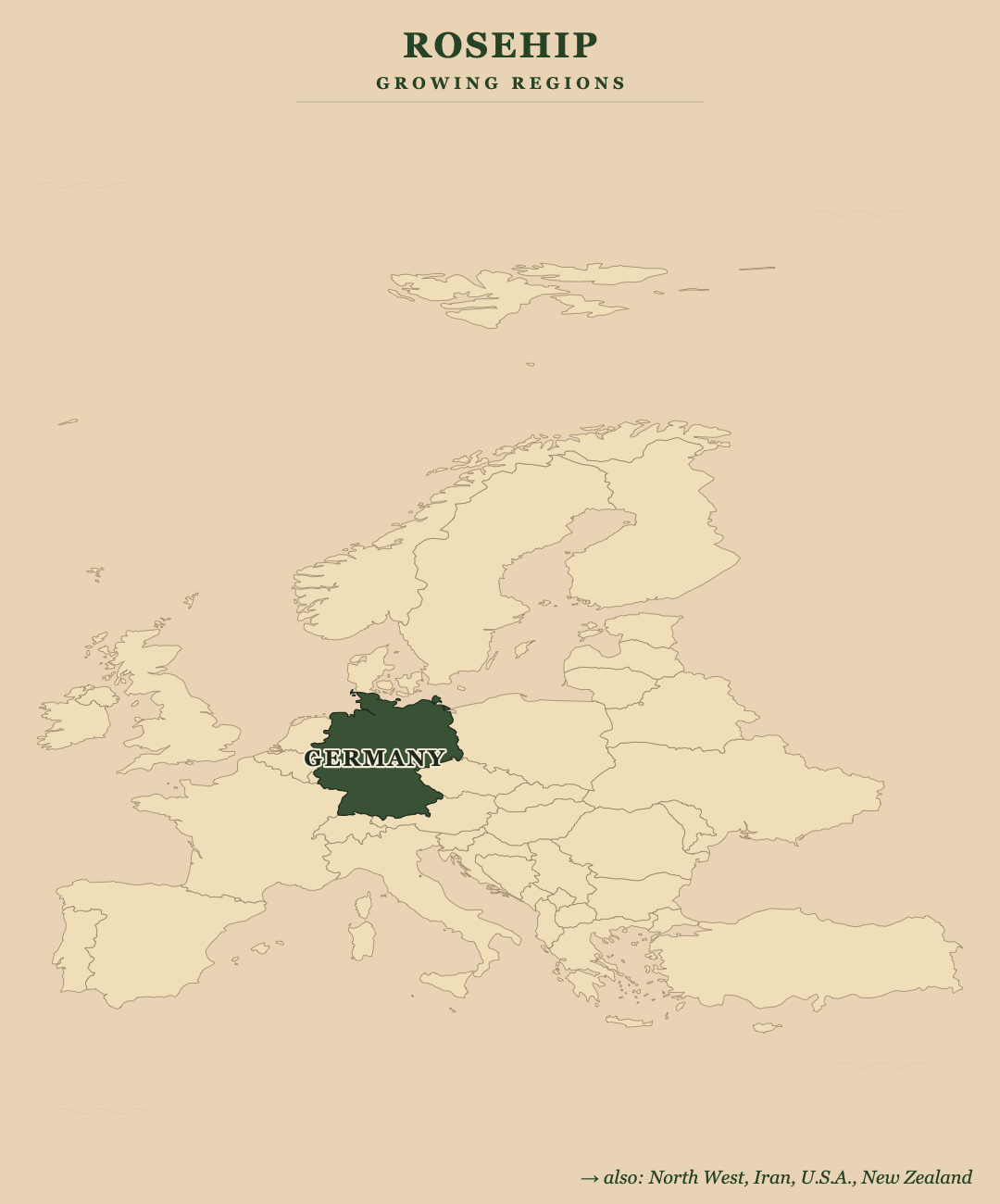
Rosehip is primarily cultivated in Europe, with secondary growing regions in Northwest Africa, Western Asia, North America (naturalised), New Zealand (naturalised).
Spice Story
The rosehip and the rose are siblings from the same shrub — the flower and the fruit — but they are entirely different ingredients in the glass. Where the rose petal brings a soft, perfumed floral note, the hip is the bracing, vitamin-rich counterpoint: tart, earthy and robustly fruity. Wild rosehips pack an extraordinary 426 milligrams of vitamin C per 100 grams — roughly eight times the level in a fresh orange. [source] That fact wasn't lost on wartime Swedes, who have long made nyponsoppa — a hot rosehip soup served with almond biscuits, a comfort and a vitamin fix rolled into one bowl. [source] In Hungary the hips go into pálinka, the fruit brandy that has fuelled Eastern European winters for centuries. [source] The same wild, tangy character makes rosehip a compelling but still underused player in contemporary gin.
Gin Creativity
Rosehip adds a tartness that cuts through juniper's resin — it's a fruit-forward botanical with enough wild, earthy backbone to hold its own rather than simply sweeten. A full sachet leans a gin into hedgerow territory with punchy tannic fruit; a partial amount adds a quiet tartness and rosy warmth without dominating. Pair it with rose to double up on the plant's flower-and-fruit poetry, lean into sloe for a layered British hedgerow profile, or balance with lemon peel to keep the tartness bright and clean rather than earthy.
Blending Science
Main flavour compounds
 Vitispirane—
 Nonanal—
 alpha-Terpineol—
Pairs well with
- Rose
- Hibiscus
- Sloe
- Juniper
- Lemon peel
- Elderflower
Three compounds from Rosa canina hip GC-MS analysis define its aroma architecture. [source] Vitispirane (11.47% of total volatiles) is the hip's signature norisoprenoid — a C13 terpenoid that gives rosehip its distinctive woody, slightly camphor-tinged, old-rose character; it's the same class of compound that makes certain wines smell of earthy complexity. Nonanal (5.12%) is a C9 aldehyde with a waxy, rose-adjacent, lightly citrus quality — it anchors the fruity note and reads as warmth in the finish. Alpha-terpineol (5.09%) lifts the whole profile with a floral, piney, lilac freshness. [source] Together they explain why rosehip in the still reads as simultaneously fruity, woody and gently floral — warming but never sweet, tart but never harsh. Low heat and gentle maceration best preserves the nonanal and terpineol top notes; extended heat collapses them to flat earthiness.
Food Partners
- Dark chocolate: the hip's tannin and tartness cut through chocolate's richness the same way a berry coulis does.
- Yoghurt and cream: acid fruit loves fat — the tartness sings next to plain cultured dairy.
- Apple and quince: orchard fruit shares the hip's high-acid, low-sweetness signature; together they read as a Northern European crumble.
- Game and venison: the earthy, tannic character of rosehip stands up to rich, gamey meat in the way a traditional Cumberland sauce does.
- Vanilla custard: warm custard softens the tartness and echoes the nonanal's waxy-fruity warmth.
- Hard cheese (cheddar, manchego): the hip's acidity performs the same cut-and-complement role as quince paste on a cheese board.
Cocktails To Try

- Rosehip G&T: a rosehip-forward gin over premium tonic with a fresh thyme sprig — lets the wild-hedgerow character carry without competition.
- Autumn Sour: rosehip-infused gin, lemon, egg white, a dash of honey — the tartness of the hip plays the same structural role as passionfruit in a classic sour.
- Hedgerow Collins: rosehip gin, sloe, lemon, soda — a British hedgerow highball that leans into the seasonal, tannic fruit tradition.
Release The Flavour
- Heat: keep maceration cool to warm, not boiling — the nonanal and terpineol top notes evaporate quickly; gentle is better.
- Alcohol: spirit at 40–50% pulls the fruity and woody character cleanly; water-based infusion (for syrups) needs longer and extracts more tartness and colour.
- Time: dried pipped hip gives good character within 24–48 hours in spirit; whole dried hip needs 3–5 days to open up fully.
- Prep: always pip the hips first — the seed hairs don't affect flavour but will give an unpleasant texture to any un-strained product.
Discover more
From the same region



Same flavour family
Surprise me

Sources & Citations
- scientific_name (Rosa canina L., ACCEPTED, Rosaceae):GBIF Backbone Taxonomy, usageKey 3002461 — api.gbif.org/v...
- plant_form (1–5 m shrub, hooked prickles, arching stems, flowers June–July pale pink/white, hips oval 1.5–2 cm red-orange, September–October):en.wikipedia.org/wiki/Rosa_canina
- native_range (Europe, NW Africa, W Asia; naturalised North America, New Zealand, Australia):en.wikipedia.org/wiki/Rosa_canina ; pfaf.org/user/Plant.a...
- seed_oil_fatty_acids (linoleic acid 35–56%, alpha-linolenic 20–30%):en.wikipedia.org/wiki/Rosa_canina
- traditional_medicine (colds, scurvy, gastritis, diarrhoea):pfaf.org/user/Plant.aspx?LatinName=Rosa+canina
- vitamin_C (426 mg per 100g wild rosehip; ~8× more than oranges/lemons at 53 mg/100g):Wikipedia 'Vitamin C — Natural sources', citing USDA Nati...
- compounds_vitispirane_nonanal_alphaterpineol (11.47%, 5.12%, 5.09% of total volatiles; Rosa canina fruit GC-MS):Hajdari A, Kelmendi N, Mustafa G, Mustafa B, Nebija D. 'V...
- pubchem_cids (vitispirane 6450832, nonanal 31289, alpha-terpineol 17100):PubChem compound lookup — pubchem.ncbi.nlm.nih.gov/compou...
- alphaterpineol_aroma (pine, terpenic, lilac, citrus, woody, floral):en.wikipedia.org/wiki/Alpha-terpineol
- nyponsoppa (Swedish rosehip soup; Rosa canina and Rosa rugosa used):en.wikipedia.org/wiki/Nyponsoppa
- palinka_rosehip (rosehips used to make pálinka, traditional Hungarian fruit brandy):en.wikipedia.org/wiki/Rose_hip
- hip_composition (65.2% water, 17.3% carbohydrates, 0.7% lipids):en.wikipedia.org/wiki/Rosa_canina
- hero_image:iStock royalty-free licence (asset 1338205098)
