
RASPBERRY

- Botanical name
- Rubus idaeus
- Also known as
- Red Raspberry, European Raspberry, European Red Raspberry
- Main flavour compound
- beta-Ionone
- Part used
- Fruit (the berry — fresh, frozen or as juice)
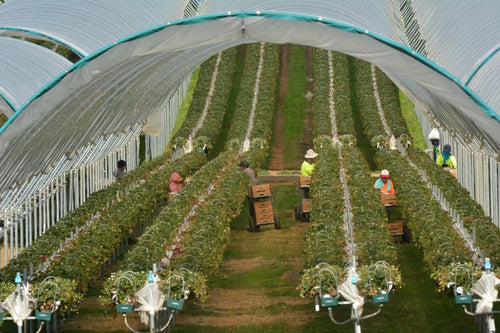
- Method of cultivation
- A deciduous, suckering cane fruit of the rose family (Rosaceae), throwing up biennial prickly canes from a perennial root. It is native to Europe and northern Asia, growing wild in forest clearings and open stands beneath the canopy, and in the south of its range it retreats to cool mountain altitudes.
- Commercial preparation
- Raspberries are hand- or machine-harvested fully ripe and are highly perishable, so most fruit destined for flavour work is frozen or pressed to juice within hours. For gin, raspberries are commonly steeped in the base spirit and either redistilled or infused after distillation, the latter also lending the spirit its natural pink blush.
- Non-culinary uses
- The leaf of the same plant (see the separate raspberry-leaf entry) has a long herbal tradition; the berry itself is prized chiefly as food, dye and flavouring.
The raspberry — Rubus idaeus — is a deciduous, suckering cane fruit of the rose family, sending up prickly biennial canes from a long-lived root, and growing wild across Europe and northern Asia in forest clearings and the open ground beneath the canopy. [source] In the warm south of its range it climbs for the cool, lingering only at mountain altitudes. [source] What you pick is not one fruit but a cluster of tiny drupelets, each a bead of juice, pulling cleanly off its core to leave that hollow thimble — a berry built, quite literally, around an empty centre.
Fresh or frozen whole
The everyday distiller's form — macerate in base spirit, then redistil for a dry, perfumed result or infuse post-distillation for colour and sweetness.
Juice or purée
Pressed fruit gives the most intense colour and jammy sweetness; best added after distillation as it carries sugar and pigment that will not come over the still.
Region of cultivation
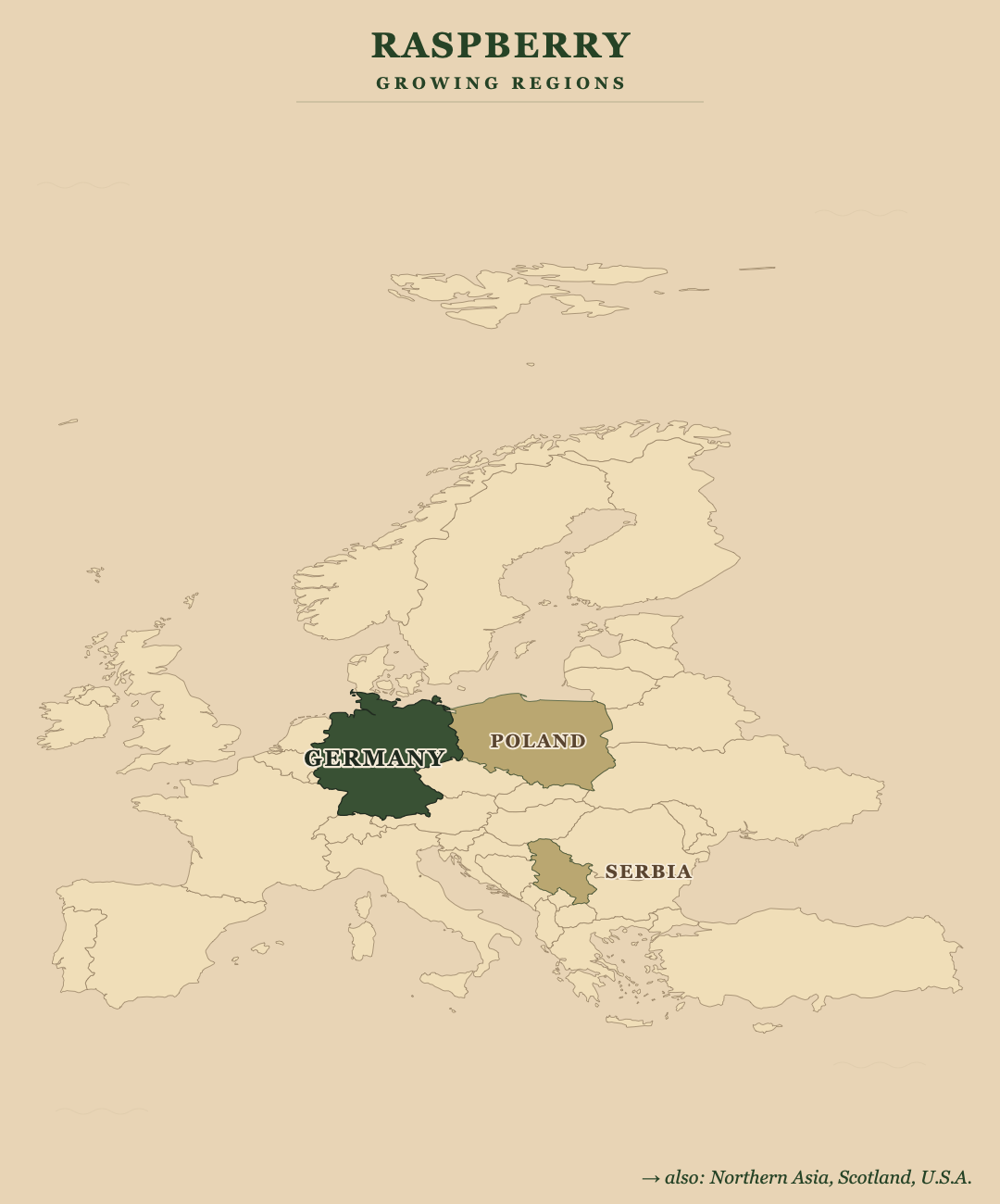
Raspberry is primarily cultivated in Europe, Northern Asia, with secondary growing regions in Scotland, Serbia, Poland, Pacific Northwest USA.
Spice Story
The raspberry has carried its birthplace in its name for two thousand years. The species epithet idaeus points to Mount Ida, near Troy in what is now north-west Turkey, where the ancient Greeks knew the wild fruit best. [source] Pliny the Elder, writing in the first century, called them "Ida fruits," gathered from the slopes of that same mountain; the Roman agriculturist Palladius described growing them three centuries later, and raspberry seeds have turned up at Roman forts in Britain — evidence the legions carried the plant across their empire. [source] Systematic cultivation, though, is a more recent affair, only really beginning around four hundred years ago. [source] For most of its history, then, the raspberry was a wild thing — foraged from forest edges long before anyone thought to plant it in rows.
Gin Creativity
Raspberry is a charmer of a botanical — sweet, tart and unmistakably perfumed, with that violet-floral lift that reads as "raspberry" before your tongue has even caught up. Redistilled, it gives a dry, elegant, almost rosé-like aromatic that keeps a gin crisp; infused after the still, it floods the spirit with jammy sweetness and a natural pink blush. It sits beautifully alongside juniper's pine, loves the company of rose and hibiscus, and a squeeze of lemon stops the fruit tipping into jam. Use it to add a romantic, summer-garden top note rather than to dominate.
Blending Science
Main flavour compounds
 beta-Ionone—
 alpha-Ionone—
 Raspberry ketone—
 Linaloolfloral, soft
Raspberry's aroma is a story of small molecules doing enormous work. The defining note comes from the ionones — β-ionone carries the highest odour-activity value of any compound in red raspberry juice (a remarkable 9507), lending its violet, floral, woody character, with α-ionone alongside it; together they are the signature the nose reads as "raspberry," regardless of cultivar. [source] [source] The namesake raspberry ketone is present only in trace — just 1–4 mg per kilogram of fruit — yet it lends that instantly recognisable confected sweetness. [source] A whisper of linalool adds floral-citrus brightness and ranks among the genuinely significant red-raspberry odorants. [source] Because so much of the magic is in delicate, low-boiling aromatics, gentle handling matters; the sugars and pink pigment, by contrast, will not come over the still and are best added by infusion.
Food Partners
- Dark chocolate: the classic counterpoint — raspberry's tart-floral edge cuts cocoa's richness.
- Soft and goats' cheeses: sweet-sharp fruit against creamy, lactic tang.
- Almond and frangipane desserts: raspberry and almond are an old, faultless marriage.
- Game and duck: a raspberry glaze lifts rich, dark meat the way redcurrant does.
- Vanilla cream and panna cotta: the violet-floral ionone note sings against soft vanilla.
Cocktails To Try

- Raspberry Gin Fizz: the long, frothy classic of gin, lemon, sugar and soda, with muddled raspberries shaken through — the violet-floral fruit perfumes the foam and stains the whole glass a soft summer pink.
- Ramos Raspberry Fizz: the legendary New Orleans cream fizz of gin, citrus, sugar, egg white and orange-flower water, lifted with a little raspberry — the berry's ionone perfume sits gorgeously against the silky, floral cream.
- Raspberry Martinez: the Martini's sweeter ancestor of gin, sweet vermouth and maraschino, brightened with a raspberry-forward gin — the perfumed fruit deepens the maraschino's cherry note into something rich and rosé-like.
Release The Flavour
- Heat: keep it gentle — the violet ionones and floral terpenes are delicate; redistil low and slow to carry them cleanly.
- Alcohol: a fine solvent for raspberry's perfumed aromatics; macerate fresh or frozen fruit in your base spirit before distilling.
- Two ways in: redistil for a dry, aromatic, colourless result, or infuse after the still for jammy sweetness and natural pink colour — the sugars and pigment will not distil.
- Less is more: raspberry perfumes and rounds; use it to lift juniper and floral botanicals, not to bury them.
Discover more
From the same region


Same flavour family
Surprise me

Sources & Citations
- scientific_name (Rubus idaeus L., Rosaceae):GBIF Backbone Taxonomy, usageKey 2993094 (Rubus idaeus L....
- plant_form_and_native_range (deciduous suckering cane fruit, Rosaceae; native Europe + northern Asia; forest clearings/open stands; retreats to mountain altitudes in the south):en.wikipedia.org/wiki/Rubus_idaeus
- etymology_mount_ida (species name idaeus refers to Mount Ida near Troy, NW Turkey, where the Greeks knew it):en.wikipedia.org/wiki/Rubus_idaeus
- history_pliny_palladius_romans (Pliny the Elder described "Ida fruits" 1st c. AD; Palladius 4th c.; seeds at Roman forts in Britain; Romans spread cultivation; systematic cultivation ~400 years ago):en.wikipedia.org/wiki/Rubus_idaeus
- aroma_key_compounds (alpha/beta-ionone, linalool, nerol, geraniol and raspberry ketone among the most significant red-raspberry odorants; ionones characteristic regardless of cultivar; ~276 volatiles reported):Volatile Compounds of Raspberry Fruit: From Analytical Me...
- beta_ionone_OAV (beta-ionone highest OAV 9507, flavour-dilution factor 512; floral/grassy; 14 volatiles with OAV>=1; GC-MS/GC-O molecular sensory study of red raspberry juice cv. Heritage):Insights into the major aroma-active compounds in clear r...
- raspberry_ketone_trace (raspberry ketone occurs at trace levels 1-4 mg/kg in Rubus idaeus fruit):premierepeau.com/pages/glossary-terms/raspberry
- gin_edinburgh (Edinburgh Gin Raspberry — distilled with fresh Scottish raspberries and raspberry leaves):www.edinburghgin.com/raspberry-gin
- gin_weetwood (Weetwood Ales Raspberry Gin — raspberries used during distillation with 15 other botanicals, then masses of raspberries infused after for flavour and natural pink colour):www.weetwoodales.co.uk/shop/craft-spirits/buy-raspberry-gin/
- compound_cids (PubChem):PubChem CIDs — beta-ionone 638014, alpha-ionone 5282108, raspberry ketone 21648, linalool 6549, geraniol 637566
- hero_image:iStock royalty-free licence (asset 496824466)
