
NORTHERN SANDALWOOD

- Botanical name
- Santalum lanceolatum
- Also known as
- Desert Quandong (not the same as Quandong fruit), True Sandalwood, Plumwood, Queensland sandalwood
- Main flavour compound
- Alpha-Santalol
- Part used
- Dried heartwood and rootwood (chipped or distilled)
- Method of cultivation
- Small tree of the Santalaceae family, hemiparasitic (it partially parasitises host plant roots for water and nutrients), widespread across the Australian rangelands and outback — Western Australia's Kimberley and Pilbara, much of the Northern Territory, western Queensland, western NSW and into northern South Australia and north-west Victoria. The tree grows 4–7 metres tall and produces small fragrant flowers and edible fruits.
- Commercial preparation
- Heartwood is chipped or steam-distilled for the essential oil. Northern Sandalwood is considered a more ecologically responsible alternative to imported Indian sandalwood, which has been over-harvested historically. Commercial cultivation is expanding in Western Australia, supported by Indigenous-owned harvest operations.
- Non-culinary uses
- Foundational traditional Indigenous Australian medicinal and ceremonial use across the rangelands — the fruit was eaten, leaves placed on beds for rheumatic conditions, leaves and wood burned in smoke-cleansing ceremonies; commercial perfumery base note (a sustainable alternative to Indian sandalwood); cosmetics; aromatherapy.
Northern Sandalwood — Santalum lanceolatum — is a small tree of the Santalaceae family, widespread across the inland and northern rangelands of Australia. The plant is hemiparasitic — its roots tap into the roots of host plants to obtain water and nutrients — and grows 4–7 metres tall, with small fragrant flowers and edible fruits that have been a traditional bush food for Indigenous peoples across its range. [source] The aromatic heartwood is what we use for the essential-oil and spirit trade.
Wood chips or shavings
The standard form — slow extraction.
Sawdust
Faster extraction.
Region of cultivation
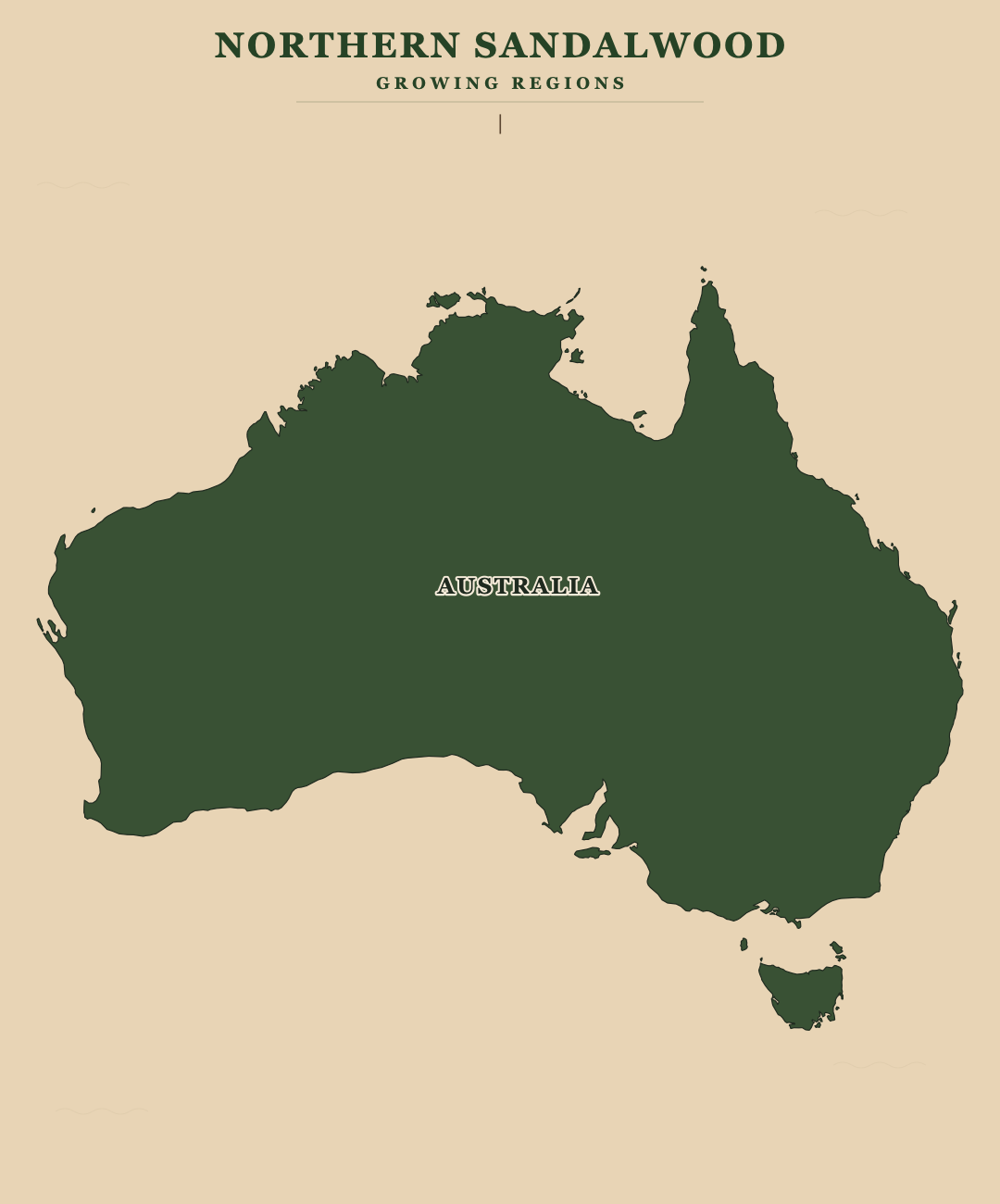
Northern Sandalwood is native to Australia, Australia — Kimberley and Pilbara WA, NT, western Qld, western NSW, with secondary growing regions in Northern SA, north-west Vic. |
Spice Story
Northern Sandalwood has been used by Aboriginal peoples across the Australian rangelands for tens of thousands of years — the fruit was eaten, the leaves placed on beds and used in traditional medicine, and (most importantly) the wood was burned in smoke-cleansing ceremonies that remain an essential cultural practice across much of inland Australia. Modern commercial harvest is increasingly Indigenous-owned and ecologically managed, making Northern Sandalwood a more sustainable alternative to imported Indian sandalwood (which has been over-harvested historically and is now CITES-listed). [source] In gin, Northern Sandalwood provides a soft, honey-and-wood character distinct from imported sandalwood — slightly drier, more eucalypt-edged.
Gin Creativity
Northern Sandalwood brings warm woody character with soft honey and orange notes. A full sachet pushes a gin firmly into clearly woody-base-note territory; a quarter to half sachet provides quiet structural depth that integrates with juniper. Pair with Buddha Wood for layered Australian wood character, or with Kunzea and Pepperberry for a fully native bush blend.
Blending Science
Main flavour compounds
 Alpha-Santalol—
 Beta-Santalol—
 Sesquiterpene alcohols—
Pairs well with
Alpha-santalol and beta-santalol are the defining sandalwood compounds — sesquiterpene alcohols responsible for the characteristic creamy-woody-warm character. Santalum lanceolatum has lower santalol concentrations than Indian Santalum album, contributing to its softer, drier character. Other sesquiterpene alcohols add body and depth. Heat-stable; long extraction is needed for full development.
Food Partners
- Smoked meats — sandalwood and smoke complement each other.
- Native bush spice rubs — sandalwood with pepperberry and lemon myrtle.
- Dark honey desserts — sandalwood and leatherwood honey.
- Aged cheese — sandalwood-gin reduction.
- Slow-braised game — kangaroo and venison.
Cocktails To Try

- Northern Negroni — Northern Sandalwood gin, Campari, vermouth.
- Bush Old Fashioned — Northern Sandalwood gin, native honey syrup, native bitters.
- Smoke Sour — Northern Sandalwood gin, lemon, honey.
Release The Flavour
- Long extraction — 48+ hours for full santalol development.
- Chip finely — increases surface area.
- Heat-friendly — both vapour and warm maceration work.
- Source matters — sustainable Indigenous-managed Northern Sandalwood is the ethical premium grade.
Discover more
From the same region
Pairs well with
Same flavour family
Surprise me

Sources & Citations
- scientific_name (Santalum lanceolatum, Santalaceae):essentiallyaustralia.com.au/product/australian-northern-s...
- range (Kimberley to NT to Qld to NSW):essentiallyaustralia.com.au/product/australian-northern-s...
- indigenous_traditional_uses:www.alchemicabotanica.com/products/sandalwood
- ecologically_responsible_alternative_to_indian_sandalwood:botanicagaiawholesale.com/products/wildcrafted-queensland...
- hemiparasitic_lifecycle:www.tandfonline.com/doi/full/10.1080/00049158.2018.1543567
- main_flavour_compounds (CSV-sourced):inputs/source.csv — Northern Sandalwood row
