
GREEN TEA

- Botanical name
- Camellia sinensis
- Also known as
- Cha, Sencha, Gyokuro, Lü Cha
- Main flavour compound
- Linalool
- Part used
- Leaf — picked young, then heat-fixed (pan-fired or steamed) to halt oxidation
- Method of cultivation
- An evergreen shrub or small tree of the family Theaceae, kept clipped to waist height on plantations across warm, humid, often high-altitude country. The same plant yields green, oolong and black tea — the difference is entirely in the processing, not the leaf.
- Commercial preparation
- For green tea the freshly plucked leaves are heated almost immediately — pan-fired (Chinese style) or steamed (Japanese style) — to deactivate the enzymes that would otherwise drive oxidation, then rolled and dried. This is what keeps green tea green and vegetal rather than brown and malty. For gin, the dried leaf is typically steeped (macerated) in the spirit for a measured window rather than boiled, to draw the aromatics without stripping harsh tannin.
- Non-culinary uses
- Green tea leaf is rich in catechin polyphenols (notably EGCG) and the amino acid L-theanine, and is widely used as a source of antioxidants and as a flavour/colour agent beyond the cup.
Green tea is not a plant of its own but a way of treating one. The shrub is Camellia sinensis — an evergreen of the family Theaceae, kept clipped to waist height across warm, humid, often mountainous country, where it throws out the tender young shoots that are picked for tea. [source] The very same leaf, depending only on how it is handled after picking, becomes green, oolong or black tea — the difference is in the processing, never the plant. [source] Green tea is simply the leaf caught early and held still.
Loose leaf (whole)
The distiller's form — steep in base spirit for a short, controlled maceration; over-long contact pulls bitter tannin.
Sencha / gyokuro grade
Steamed Japanese greens lean marine and umami-sweet; prized where you want savoury depth rather than grassy bite.
Region of cultivation
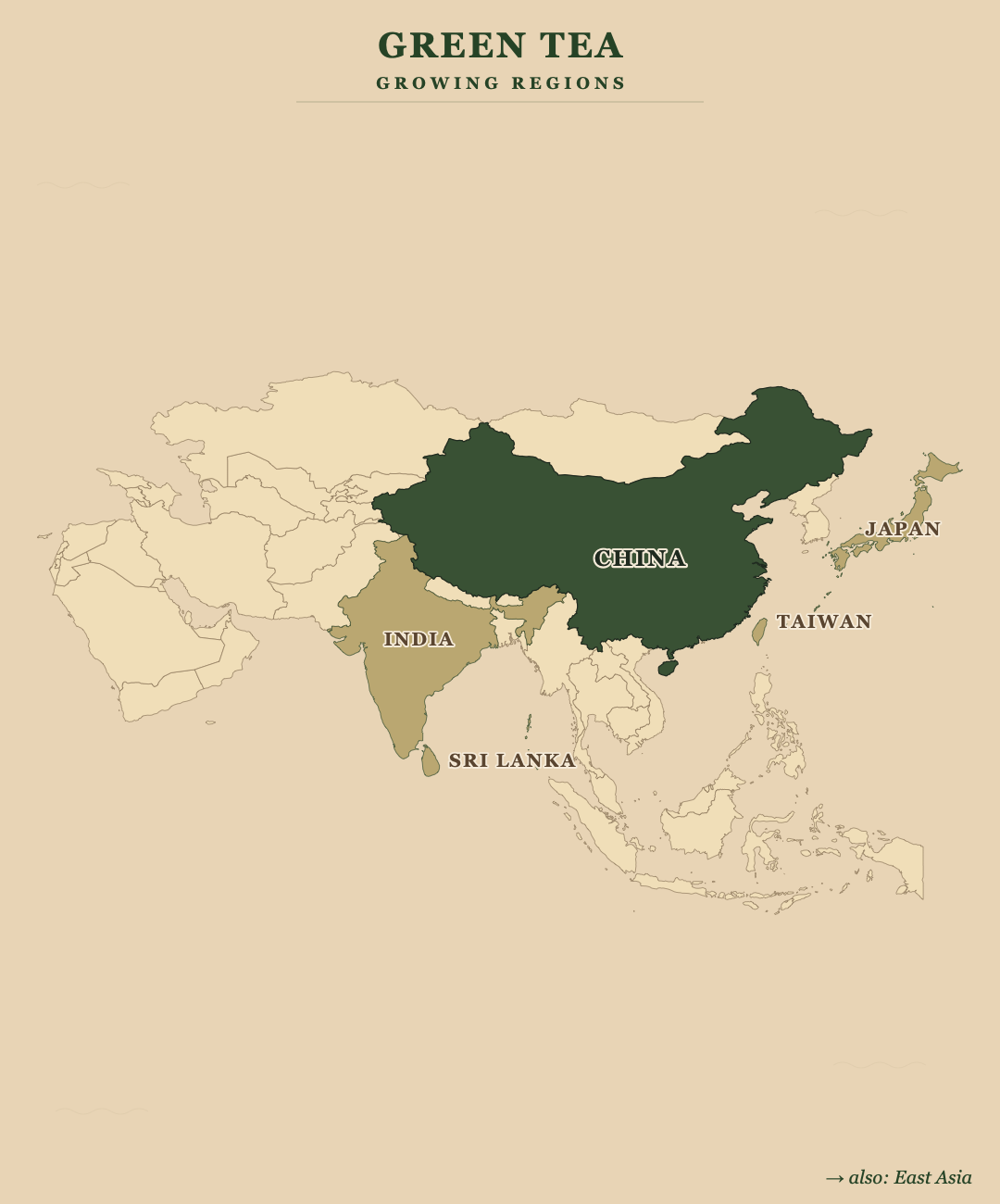
Green Tea is primarily cultivated in China, East Asia, with secondary growing regions in Japan, India, Sri Lanka, Taiwan.
Spice Story
What makes a tea "green" is restraint. The freshly plucked leaves are heat-fixed almost at once — pan-fired in the Chinese manner or steamed in the Japanese — to switch off the enzymes that would otherwise turn them brown, so green tea ends up one of the least processed teas of all. [source] That single choice of method writes the whole character: Japanese steamed greens lean marine, sweet and savoury, while Chinese pan-fired greens read of chestnut, beans and sweet hay. [source] Beneath the aroma sits the tea's other half — the taste. Catechin polyphenols, which make up some 70–80% of the leaf's polyphenols and are led by EGCG, carry the bitterness and the dry, mouth-puckering astringency; the amino acid L-theanine and glutamate answer back with a soft, savoury umami that quietly tames them. [source] [source]
Gin Creativity
Green tea is a botanical of nuance, not noise. Used with a light hand it lends a gin a fresh-grassy, faintly floral top note and a savoury, almost tannic depth on the back palate that few other botanicals can give. It is a natural partner to citrus — grapefruit and lemon peel sharpen its green lift — and it sits comfortably against juniper and coriander seed rather than fighting them. The danger is steeping it too hard: leave the leaf in too long and you pull the bitter, drying tannin that belongs in a teapot, not a glass. Treat it as you would a delicate tea: a short, measured infusion, then stop.
Blending Science
Main flavour compounds
 Linaloolfloral, soft
 Geraniolrose, soft floral
 (E)-2-Hexenal—
 Dimethyl sulfide—
Pairs well with
- Juniper
- Lemon peel
- Grapefruit peel
- Coriander seed
- Yuzu
The aroma a still actually captures from green tea is led by floral terpene alcohols. Linalool is the most abundant aroma compound in the leaf, bringing a sweet, woody-floral, citrus lift, and geraniol adds a rosy floral roundness — together they are the engine of the most fragrant, "floral-type" green teas. [source] Cutting across that florality is (E)-2-hexenal, the fresh-cut green-leaf note that reads as unmistakably "grassy," and a trace of dimethyl sulfide — a sulfur compound with so low an odour threshold that, despite its tiny quantity, it carries the highest odour activity of all and lends that cooked-vegetal, marine edge. [source] Keep extraction gentle and cool; the green and sulfur top notes are the first to be lost to heat and time.
Food Partners
- Sushi and sashimi: green tea's marine, umami register is the classic match for raw fish.
- Steamed white fish: clean, savoury and delicate — it flatters rather than overwhelms.
- Citrus desserts: the floral linalool-geraniol lift bridges beautifully to lemon and yuzu.
- Soft fresh cheeses: the leaf's gentle astringency cuts creaminess.
- Stir-fried greens: echoes the grassy (E)-2-hexenal note on the plate.
Cocktails To Try

- Green Tea Southside: the cooling classic of gin, lime, sugar and mint, with a green-tea gin in the lead — the grassy-floral leaf doubles down on the mint and turns the whole drink into something garden-fresh and savoury-edged.
- Sencha Gin Rickey: the clean, dry classic of gin, fresh lime and soda, built on a green-tea gin — long and savoury-fresh, the grassy leaf and sharp lime reading like an iced sencha with a backbone.
- Umami Vesper: the famous gin, vodka and Lillet classic, stirred very cold and built on a green-tea gin — the leaf's marine, almost dashi-like savouriness gives the steely Vesper an unexpected, moreish depth.
Release The Flavour
- Heat: keep it low — gentle, cool extraction protects the floral and green top notes; high heat flattens them and drives off the delicate sulfur lift first.
- Time: the danger is steeping it too hard. Leave the leaf in too long and you pull the bitter, drying tannin that belongs in a teapot, not a glass. Treat it like a delicate tea — a short, measured infusion, then stop.
- Alcohol: distillation pulls none of that tannin or bitterness, but in a macerate it's a different game: alcohol draws the aromatic terpenes well, yet it also extracts tannin readily, so watch the clock more closely than you would a citrus peel.
- Less is more: green tea adds nuance, savoury depth and a grassy-floral lift — use it to shade a gin, not to dominate it.
Discover more
From the same region

Pairs well with
Surprise me

Sources & Citations
- scientific_name (Camellia sinensis (L.) Kuntze, Theaceae):GBIF Backbone Taxonomy, usageKey 3189635 (Camellia sinens...
- processing (green tea = unoxidised leaf; heat-fixed by pan-firing or steaming to halt oxidation; one of least processed teas):www.botanichealthcare.net/news-and-blog/green-tea-a-herba...
- processing_regional (steaming = Japanese style, marine/sweet/savoury; pan-firing = Chinese style, chestnut/beans/hay):www.tea-and-coffee.com/blog/tea-oxidation
- catechins_EGCG (catechins = 70-80% of tea polyphenols; EGCG ~59% of catechins; catechins drive bitterness and astringency):www.sciencedirect.com/science/article/abs/pii/S0308814618...
- theanine_umami (L-theanine / glutamate impart umami; umami amino acids inhibit catechin bitterness and astringency):ift.onlinelibrary.wiley.com/doi/10.1111/1750-3841.16543
- aroma_linalool_geraniol_bionone (linalool most abundant aroma compound; geraniol + beta-ionone key floral-type drivers; GC-MS):GC-MS Combined with Proteomic Analysis of Volatile Compou...
- aroma_dms_dms_OAV (dimethyl sulfide highest OAV ~458, asparagus/marine note; key odorant with linalool and trans-beta-ionone):www.sciencedirect.com/science/article/abs/pii/S0963996923...
- compound_cids (PubChem):PubChem CIDs — linalool 6549, geraniol 637566, (E)-2-hexenal 5281168, dimethyl sulfide 1068
- gin_beefeater24 (Beefeater 24 — 12 botanicals incl. Japanese Sencha + Chinese green tea; Desmond Payne; 24h steep):www.theginguild.com/ginopedia/gin-brands/beefeater-24-gin/
- gin_kinotea (Ki No Tea, The Kyoto Distillery — gin built on Uji tencha & gyokuro green tea):www.theginguild.com/ginopedia/gin-brands/ki-no-bi-tea-edi...
- hero_image:iStock royalty-free licence (asset 482765659)
