
BUTTERFLY PEA

- Botanical name
- Clitoria ternatea
- Also known as
- Blue Pea, Asian Pigeonwings, Anchan, Bunga Telang, Aparajita, Shankhupushpam
- Main flavour compound
- Delphinidin-3-glucoside
- Part used
- Flower (dried)
- Method of cultivation
- A perennial herbaceous legume of the Fabaceae family that grows as a vine or creeper, bearing solitary, vivid deep-blue flowers about 4 cm long with light-yellow markings. Native to equatorial Asia and cultivated as a fast-growing ornamental and nitrogen-fixing cover crop across South and Southeast Asia, where the flowers are picked for tea, food colouring and dye.
- Commercial preparation
- Flowers are harvested by hand and dried whole, then sold as loose dried petals for tea and for steeping as a natural blue colourant. The polyacylated pigment is heat-tolerant up to around 60–70°C but light-sensitive, so good product is kept dry and out of direct sun.
- Non-culinary uses
- Natural blue dye and food colourant; ornamental garden vine; nitrogen-fixing forage and cover crop; long history in Ayurvedic and Southeast Asian traditional medicine.
Butterfly Pea — Clitoria ternatea — is a slender perennial legume that grows as a vine or creeper, scrambling happily up fences and trellises across the warm tropics. [source] Its glory is the flower: a solitary, vivid deep-blue bloom about 4 cm long, marked with a flash of light yellow at the throat. [source] It is those petals — not leaf, seed or root — that the world picks, dries and steeps for one of nature's most theatrical blues.
Whole dried flowers
The standard form — steep a small handful in warm (not boiling) spirit or water to draw out the blue.
Loose petals / butterfly pea tea
Same flower sold as anchan tea; steep briefly for colour, longer for a fuller earthy note.
Region of cultivation
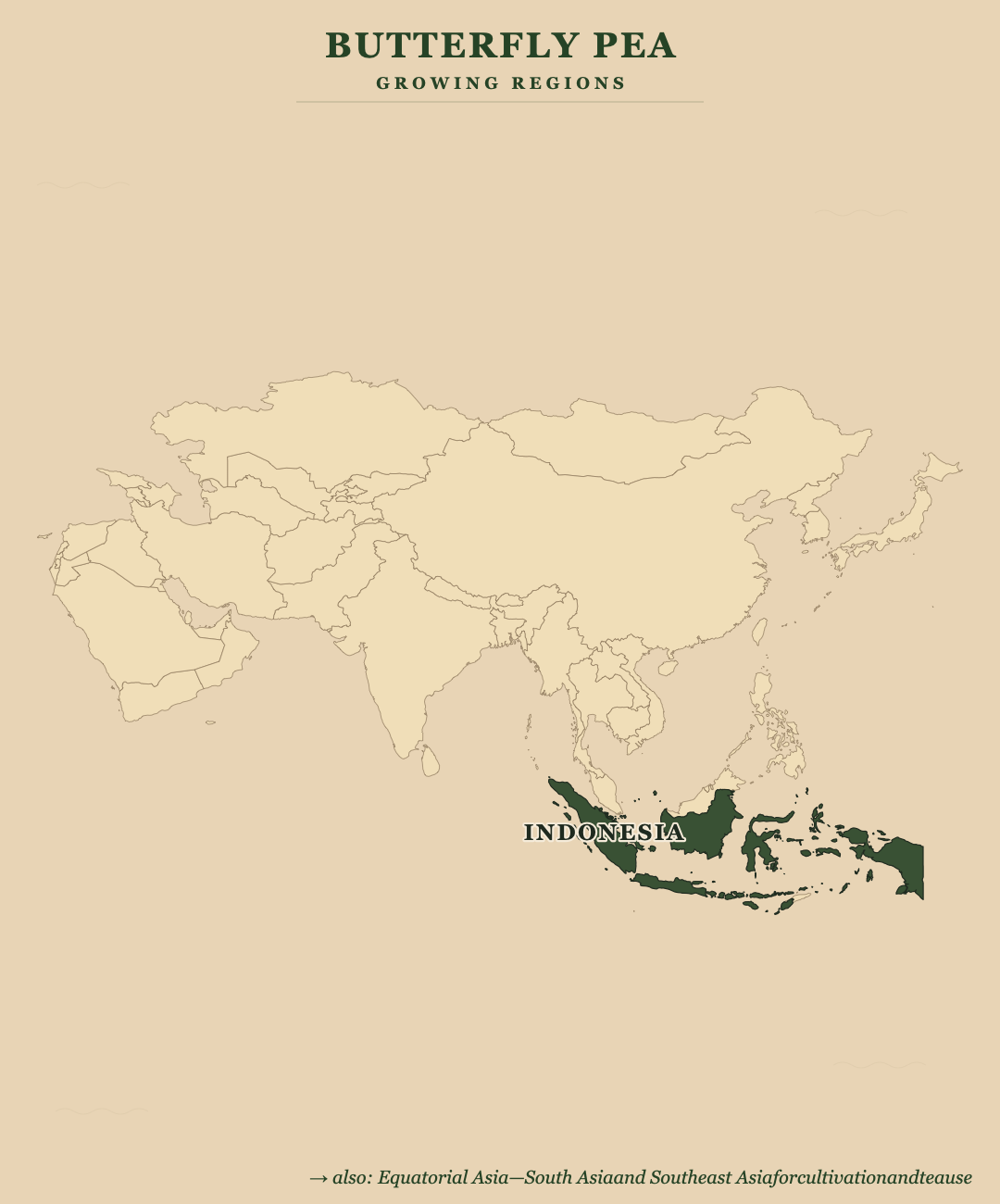
Butterfly Pea is primarily cultivated in Indonesia — Ternate, Maluku (Moluccas) — origin reflected in the species name ternatea, with secondary growing regions in Equatorial Asia — South Asia and Southeast Asia (Thailand, Malaysia, India) for cultivation and tea use.
Spice Story
This is a flower whose name carries its own passport. The species epithet ternatea points to Ternate, a small volcanic island in the Moluccas of Indonesia, from where European botanists first catalogued it — and across equatorial Asia it has been woven into kitchens for centuries. [source] In Thailand the dried petals become nam dok anchan, a deep-blue tea served sweetened with honey and lemon, the lemon tipping the cup from blue to purple. [source] In Malaysia the same blue stains the rice of nasi kerabu, and across the region the flower has coloured glutinous rice and sweets for generations. [source] What looks like a modern Instagram trick is in truth an old pigment, freshly rediscovered — the original colour-changing magic, painted in petals.
Gin Creativity
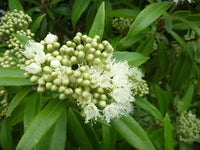
Reach for Butterfly Pea when you want a gin that performs. A full sachet steeped in your spirit pulls a deep indigo-to-purple; a partial amount gives a softer wash of colour while keeping the flower's mild, earthy note in the background. [source] It adds almost no competing flavour, so it sits behind your juniper rather than fighting it. Pair it with Lemon Myrtle or a twist of citrus at serving time — that is what triggers the blue-to-pink reveal in the glass.
Blending Science
Main flavour compounds
 Delphinidin-3-glucoside—
 Ternatins (A1–A3, B1–B4, C1–C5, D1–D3)—
 Delphinidin—
 p-Coumaric acid—
Pairs well with
Butterfly Pea is a colour botanical, not an aroma one — its character is pigment chemistry. The blue comes from ternatins, a family of polyacylated delphinidin triglucosides built on a delphinidin-3-glucoside core. [source] These anthocyanins are pH-responsive: violet-blue around pH 3.2–5.2, light blue through neutral, and red below pH 3.2 — so a squeeze of acidic citrus pulls the liquid from blue toward purple-pink. [source] The pigment is stable to around 60–70°C but light-sensitive, which is why you steep in cool spirit and keep the bottle out of the sun. [source] The flavour itself stays mild and earthy — closer to a fine green tea than to anything sweet. [source]
Food Partners
- Glutinous rice and nasi kerabu: the flower's traditional culinary home, where it dyes rice a striking blue. [source]
- Citrus desserts: a squeeze of lemon or lime turns the blue to pink — pretty on lemon tarts and posset.
- Green-tea sweets: its earthy, green-tea-like note sits naturally beside matcha and mochi.
- Honey-and-lemon drinks: the classic anchan-tea pairing, sweet against earthy.
- Clear cocktails and spritzes: lets the colour shift be the whole show.
Cocktails To Try

- Colour-changing G&T: blue butterfly-pea gin poured over ice, then tonic and a citrus squeeze to shift it to pink. [source]
- Empress 1908: the best-known butterfly-pea-coloured gin, a deep indigo from the flower. [source]
- Sharish Blue Magic / McHenry Butterfly Gin: Portuguese and Tasmanian craft examples built on the same colour-shift trick. [source]
- Blue Martini: butterfly-pea gin, dry vermouth, a twist of lemon for the reveal.
Release The Flavour
- Heat: steep in cool or barely-warm spirit, not boiling — the pigment fades above about 70°C. [source]
- Alcohol: spirit draws the blue out fast; about an hour of steeping gives an intense indigo-to-purple. [source]
- Acid: add citrus only at serving time — that is the pH trigger that flips blue to pink. [source]
- Light: keep the finished bottle out of direct sun; the colour is light-sensitive and will dull over time. [source]
Discover more
Pairs well with
Surprise me

Sources & Citations
- scientific_name (Clitoria ternatea L., Fabaceae):GBIF Backbone Taxonomy species match, usageKey 2946519 (C...
- form_and_flower (perennial legume vine, vivid deep-blue solitary flowers ~4cm with yellow markings):en.wikipedia.org/wiki/Clitoria_ternatea
- native_range_and_name (native to the Indonesian island of Ternate; equatorial / South & SE Asia; species name ternatea):en.wikipedia.org/wiki/Clitoria_ternatea
- pigments_ternatins (polyacylated derivatives of delphinidin 3,3',5'-triglucoside; 15 ternatins A1-A3,B1-B4,C1-C5,D1-D3; delphinidin-3-O-glucoside foundation):Anthocyanins From Clitoria ternatea Flower, Frontiers in ...
- pH_colour_transitions (red <3.2; violet-blue 3.2-5.2; light blue 5.2-8.2; light blue to dark green 8.2-10.2; yellow chalcone at high pH; flavylium/quinoidal/chalcone):Frontiers in Plant Science 2021, 12:792303 — www.frontier...
- stability (thermally stable ~60-70°C, degrades >100°C; good storage stability; less photostable):Frontiers in Plant Science 2021, 12:792303 — www.frontier...
- culinary_colourant (colours glutinous rice and Malaysian nasi kerabu; anchan tea in Thailand; turns purple/pink with lemon):en.wikipedia.org/wiki/Butterfly_pea_flower_tea
- flavour_mild_earthy (earthy and woody, more like a fine green tea; in gin a barely-noticeable delicate floral/earthy note):en.wikipedia.org/wiki/Butterfly_pea_flower_tea ; cocktail...
- colour_changing_gin_trend (blue/purple gin shifts to pink with citrus/tonic; mixologist theatre; brands Empress 1908, Sharish Blue Magic, McHenry, Swan River):www.craftginclub.co.uk/ginnedmagazine/everything-you-need...
- pubchem_cids (delphinidin-3-glucoside 165558; delphinidin 128853; ternatin A1 16173494):PubChem REST name lookups — pubchem.ncbi.nlm.nih.gov/
- hero_image:iStock royalty-free licence (asset 1483212272)
